





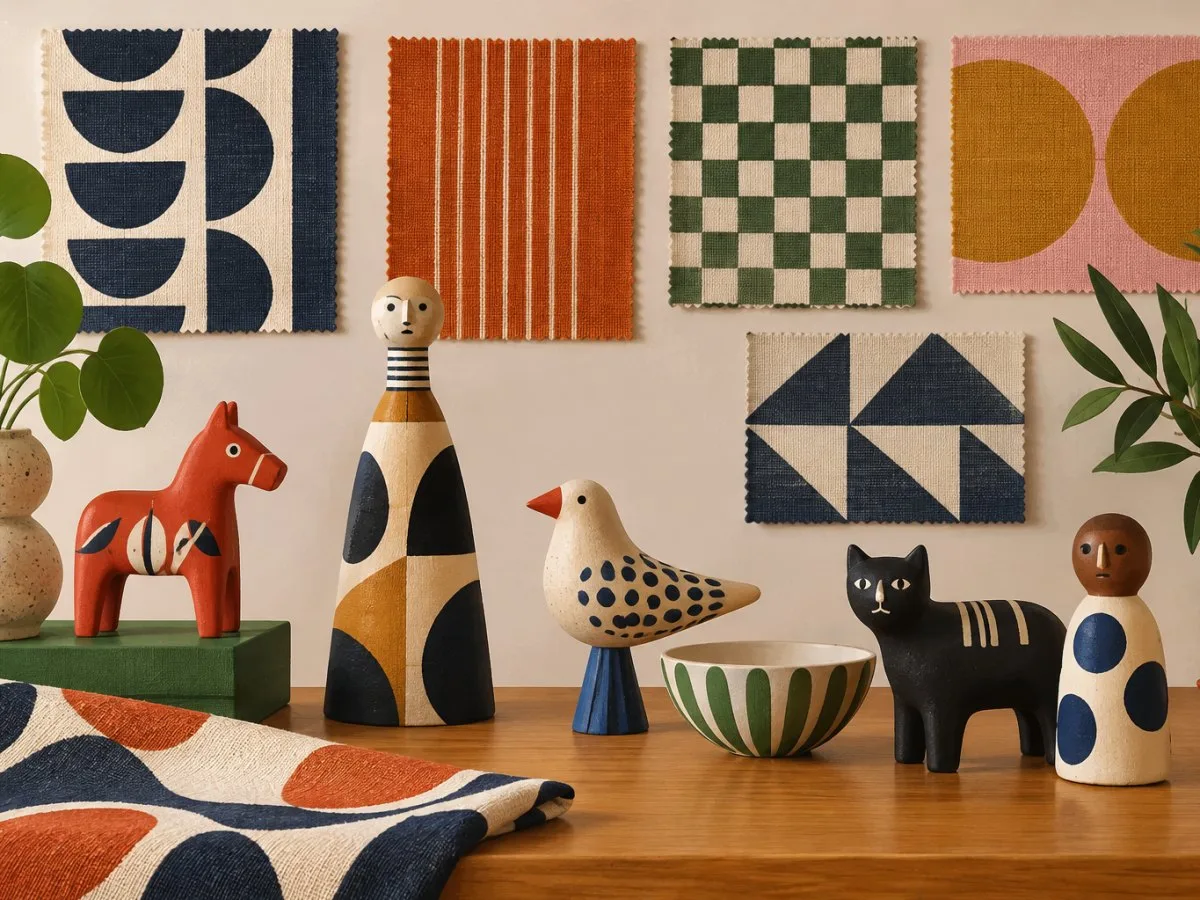
Alexander Girard (1907–1993) worked across architecture, interior design, textiles, furniture, graphics, and objects. Rather than treating these disciplines as separate compartments, he connected them to create environments in which color, motifs, and details formed part of a single composition. His legacy offers a way to see everyday design not merely as a collection of pieces, but also as a set of relationships between them.
From fabric to complete environment
When Girard became director of Herman Miller’s textile division in 1952, fabrics available for modern furniture tended to be subdued and sparsely patterned. His designs introduced vivid colors, geometric patterns, and variations that could be combined in different ways. Over the following two decades, he created more than 300 textile designs in numerous color combinations.
Textiles were only one part of a broader practice. Girard also designed wallpapers, furniture, objects, graphic materials, and interior elements. For La Fonda del Sol, a New York restaurant that opened in 1960, he conceived a complete ensemble that included the space, graphics, tableware, and staff uniforms. In 1965, for Braniff International Airways, he extended the company’s visual language across many points of contact, from tickets and waiting areas to the aircraft themselves.
In these projects, coherence did not depend on making everything identical. Instead, it emerged through the repetition and variation of colors, shapes, and motifs across objects with different functions. This approach helps explain why Girard could move from a large-scale interior project to a small graphic motif—such as his “love” design—while retaining a recognizable sensibility.
Studios that adapted to the work
Girard’s studios also expressed this blend of organization and flexibility. In his spaces in Michigan and Santa Fe, drafting tables, libraries, material samples, storage, and, at times, exhibitions coexisted. The layouts could change to suit each project: Girard moved partitions, modified desks, and rearranged work elements.
In the Kercheval Place studio in Michigan, he suspended bamboo blinds in the room to suggest planes and create a degree of privacy without always resorting to conventional walls. In Santa Fe, where he used plywood to make desks, cabinets, and shelving, he allowed the material’s grain to become part of the appearance of the furniture and wall panels.
The workspace was not entirely separate from personal life: his Santa Fe studio was on the same property as his home. In this setting, efficiency supported a varied practice rather than eliminating improvisation. Drawers and files made it possible to find samples, clippings, printed matter, and objects; at the same time, the studios could become places for gathering and exhibition.
Organizing without losing curiosity
Girard gathered many kinds of materials: textile samples, typefaces, photographs, cutout figures for models, stamps, labels, and small objects. Rather than treating them as accessories, he used them as tools for thinking and composing. He designed drawers and storage systems tailored to this variety, from small compartments to boxes for samples.
The folk-art collection he assembled over the course of his travels was an important source of inspiration. It included handmade objects from many places and eventually exceeded 100,000 items, according to the available biographical information. Some were incorporated into interiors and exhibitions. For the “Magic of a People” pavilion, created for the 1968 HemisFair in San Antonio, Girard arranged more than 10,000 pieces from his collection.
His interest in these objects did not lead to a single decorative formula. The collection offered forms, techniques, and associations that could nurture new ideas. One of the most fruitful tensions in his work lies in the coexistence of references from different origins and industrial production: modern design could include decoration and craftsmanship without giving up formal clarity.
A workspace can also be a public space
In 1947, Girard’s studio on Fisher Road in Michigan served as an exhibition salon. There he presented works and objects by well-known artists alongside crafts and folk art. The program included furniture, textiles, ceramics, jewelry, prints, and other work. Girard designed small, carefully composed invitations for each exhibition.
The studio’s use in this way broadens the idea of what a workplace can be: not just a place to produce, but also an environment for showing, gathering, and bringing objects and people into relationship. Folk-art exhibitions and displays of contemporary design were not presented as opposing worlds, but as part of a shared visual curiosity.
Seeing the everyday as a whole
Girard combined production for companies with close attention to small things. His work ranged from interiors and graphic systems to samples, labels, and objects that organized studio life. This breadth does not mean a lack of specialization; rather, it points to a practice able to carry ideas across scales and media.
When looking at an everyday space, his approach invites us to notice both each object and the relationships that make it legible: contrasts in color, repeated forms, how materials are stored and displayed, and the shift between function and decoration. There is no need to reproduce his abundance to recognize the possibility his work suggests: well-articulated details can give an entire environment its character.
At a glance
Scope
Editorial reading; this is not a site visit or a technical evaluation.
Sources and references
Alexander Girard. A Designer’s Universe ↗15/11/2026 Vitra Design Museum, “Alexander Girard. A Designer’s Universe”.
A comprehensive look at designer Alexander Girard's life ↗15/11/2026 Todd Oldham and Kiera Coffee, “Girard’s moment in the sun”, Herman Miller.
Alexander Girard ↗15/11/2026 Herman Miller, “Alexander Girard”.