





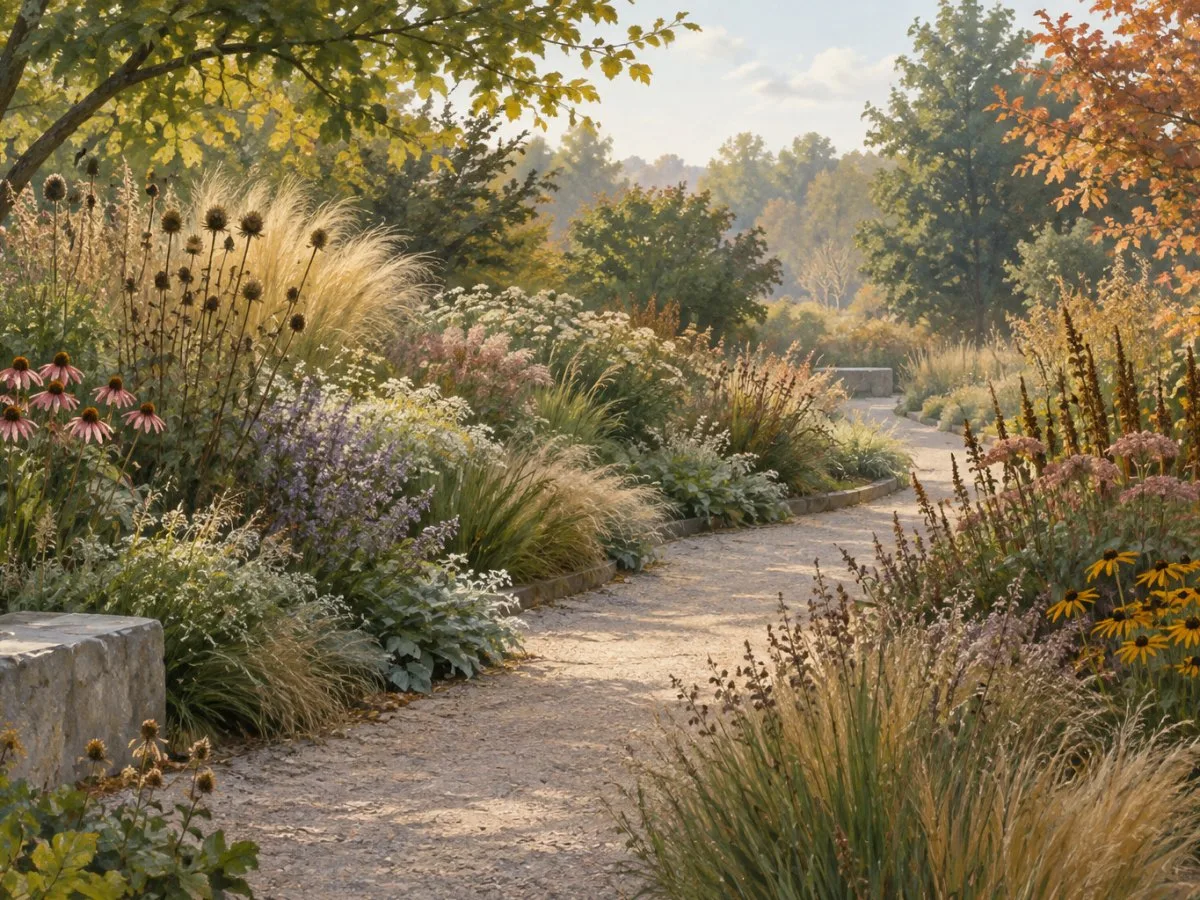
A route that invites you to pause
In front of the VitraHaus on the Vitra Campus in Weil am Rhein, Piet Oudolf’s garden is conceived as more than a green space to pass through. Its design arranges small paths without straight lines or a vanishing point at the end. Around each turn, another perspective comes into view, and visitors decide where to go next.
Movement is part of the experience: the paths are intended to encourage people to look around rather than head directly from one end to the other. Oudolf says he wants people to lose themselves in the garden. It is not a formal maze, but a route made up of decisions and partial views.
The garden covers around 4,000 square metres and brings together about 30,000 plants. Oudolf describes it as the setting for a composition of planted zones offering distinct sensory experiences, while also seeking to relate the vegetation to the surrounding architecture. These figures give a sense of the project’s scale, but do not by themselves determine how the place is experienced.
A spontaneous appearance, a precise composition
Oudolf’s plantings may look wild, but that impression does not mean they are neglected. In his approach, every plant has a planned place in the design. The natural appearance is created through deliberate decisions about where plants are placed and how they relate to one another.
Oudolf says that too many built structures are unnecessary because the focus is on the plants. For the Vitra Campus garden, he explains, they agreed to create three or four planted zones with distinct sensory experiences. The layout also opens up views of nearby buildings.
Oudolf compares plants to members of a community or performers in an ensemble. Each plant has particular strengths and a place in the garden, but should not restrict the others too much. The different plants need to work well together, each contributing its own character to the whole. This helps explain why his selection is not simply a matter of gathering attractive flowers: what matters is how the plants interact and behave together.
The plant cycle as part of the composition
In explaining his approach to garden design, Oudolf describes a composition that takes account of changes throughout the year. A plant may lose its flowers but remain interesting because of the shape of its seed heads or dried structure. In this approach, a species’ value is therefore measured not only at the height of its flowering, but also by what it contributes before and after.
Oudolf explains that he considers the interaction and character of plants first; flowering comes later in the composition. Sculptural qualities and the structures that remain after flowering can add interest in different seasons. Change is thus part of the design, not an interruption to it.
This attention to the plant cycle also qualifies the idea of “wild nature.” A free-looking appearance comes from meticulous planning, even though subsequent growth does not mean the garden stays the same. Oudolf says that plants grow, some disappear, and others may have to be replaced. He typically has an image in mind of what a garden will look like in a few years, while recognising that it will continue to evolve.
A garden in dialogue with architecture
Oudolf does not conceive of the garden as an opposition to the campus buildings or as an element subordinate to them. In his description, the vegetation adds another scale of observation: it draws the gaze from the open sky down to the ground and offers new perspectives on the surrounding buildings.
Its location in front of the VitraHaus reinforces this relationship. Oudolf says he chose the site so that people leaving the building would see a garden that beckons and welcomes them. Architecture and plants do not compete to be the sole focus; they complement each other along the route.
A public space that keeps changing
More generally, Oudolf values public gardens because they let many people experience them directly, rather than only through photographs. He has described how emotionally he responds to plants and his interest in having his work awaken strong emotions in other people. That intention does not establish how every visitor responds to the Vitra Campus garden.
Oudolf leaves it to others to decide whether his work is art. He recognises parallels with art in its relationship to ideas and points of view, aesthetics and emotions, and in the way it affects the mind and touches people. At the same time, he distinguishes a garden from a finished painting hung on a wall: his work is fluid and changeable, never finished but always the beginning of something. It is like making a painting and letting it grow and decay. A garden’s form depends on time and subsequent care.
The Vitra Campus project brings these tensions together without resolving them into a static image: order and spontaneous appearance, architecture and vegetation, design and transformation. To get lost here means accepting a route without a single answer and attending to a composition that changes with the seasons and the growth of its plants.
At a glance
Scope
Editorial reading; it does not constitute a visit or a technical assessment.