





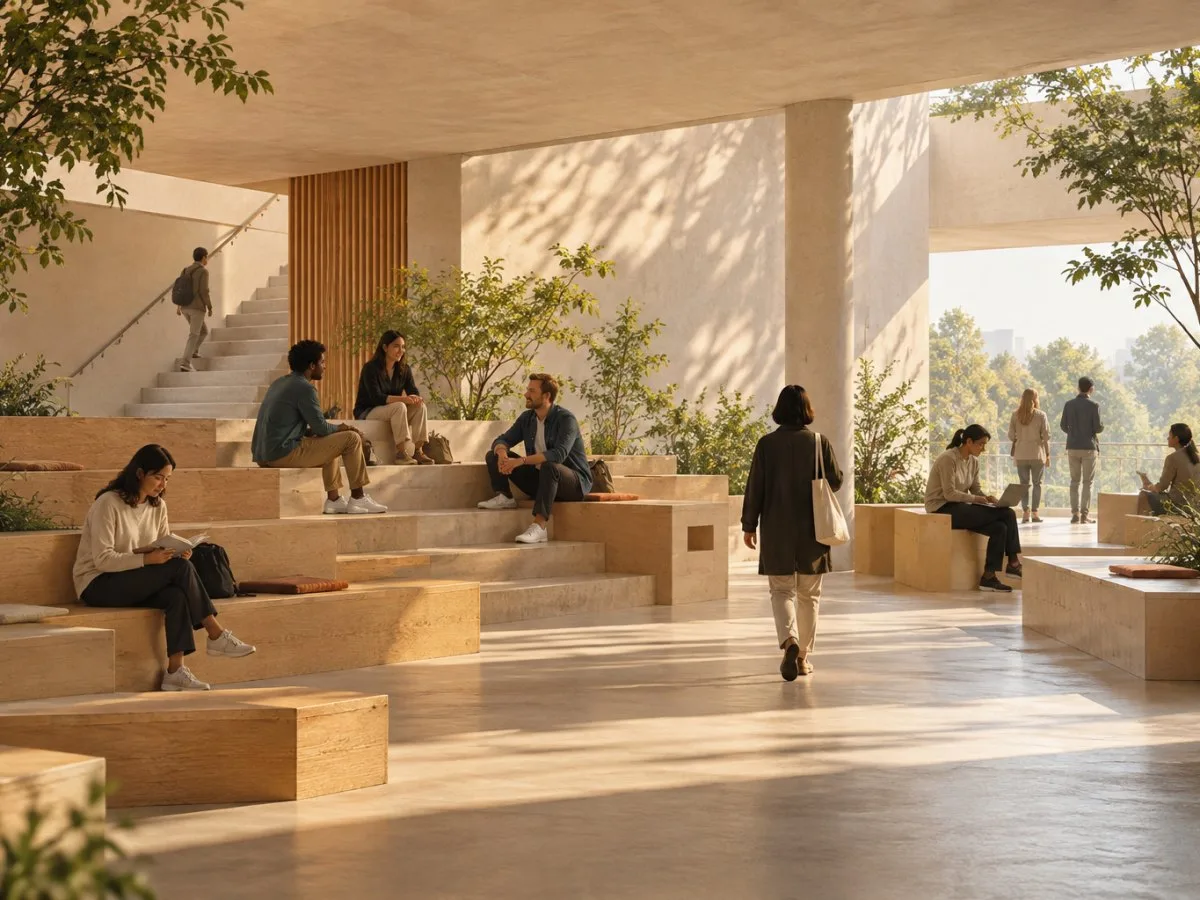
A corridor, a corner or an open area can be reduced to a route for passing through or a difficult-to-furnish nook. Reset, a modular system of stepped seating designed by Stephan Hürlemann, offers another way to see these places: they can gain structure and support gathering, pausing, concentrating or presenting, without becoming single-purpose spaces.
The idea is not that every leftover area can automatically be turned into a useful place. The conditions of each space and what people need to do there matter. Reset offers a concrete way to explore that relationship: its elements can be assembled, rearranged, dismantled and put back together, so the configuration does not have to be fixed once and for all.
Giving form without limiting use
The structure can be arranged as stepped seating, a platform, a stage, a sofa or a supporting surface. This variety shifts some of the decision-making from the initial design to everyday use: an installation can serve a meeting or presentation and then change if the activity calls for it. If a configuration works, it can also remain in place.
This flexibility is especially relevant in in-between zones: places that are not necessarily primary workstations, but need not be mere passageways either. In an office, school or lobby, furniture can give these areas a spatial identity without imposing a single activity. The distinction matters: providing structure is not the same as prescribing behaviour.
The proposal also raises a question about who decides how a space is used. Hürlemann describes Reset as a system that people can reconfigure themselves. In that sense, its potential value is not limited to adding seats: it invites people to take part in organising their surroundings. Whether that possibility leads to a sense of ownership or sustained use will depend, however, on the people and the context; the furniture does not guarantee either outcome.
A construction designed to be rearranged
Development began with wooden frames and panels that could be placed side by side or stacked. The search for a more distinctive form led to a cross-shaped base, which provides stability and defines the system’s visual character. This geometry also leaves small triangular spaces that can be used for books, plants or other objects.
The system combines panels available in OSB, dyed-through MDF and natural birch with substructure elements made of expanded polypropylene (EPP). According to the design description, the EPP contains 30% recycled material and is recyclable; the connectors are made of 100% recycled polyamide and are also recyclable. The cushions use recyclable V-Foam and a recycled-polyester cover. The cover has a zip so it can be removed and washed.
These materials and features describe the design intent and the components specified for the product; on their own, they do not establish the total environmental impact of an installation, its effective service life or the conditions for recovery at the end of use. Reuse also depends on the elements being kept in good condition and finding another use.
Modularity as an option, not a promise
The ability to dismantle and recombine the elements can help adapt a configuration when needs change. It can also free up the floor when the space is needed for another purpose. But modularity does not mean that an installation suits every place or that rearranging it has no limits: the documented proposal does not assess every building, activity or user.
The broader lesson is to take another look at spaces often considered surplus. Before assigning them a programme, it is worth asking what activities they could accommodate and how open-ended they need to be. A transitional area can support informal meetings, breaks or moments of concentration if it has a legible structure and offers different ways to use it. The intervention, in turn, should leave room for the people who occupy the place to interpret and change it.
Reset illustrates one specific response to that question: a system that gives a space form without fully determining what should happen there. Rather than turning every nook into a destination, it proposes treating in-between zones as an active part of everyday life.
At a glance
Scope
Editorial reading; this is not a site visit or a technical assessment.
Sources and references
Activating the spaces in-between | Official Vitra® Online Shop ES ↗30/10/2026 Vitra, “Activating the spaces in-between”
ID Mesh | Official Vitra® Website UN ↗30/10/2026
Reset | Official Vitra® Online Shop US ↗30/10/2026 Vitra, “Reset”