





Designing without erasing what is already there
In the summer of 2011, MoMA PS1’s courtyard hosted Holding Pattern, the winning proposal for the Young Architects Program (YAP), designed by Brooklyn-based studio Interboro Partners. Rather than altering the enclosure, the project emphasized the courtyard’s existing seven-sided polygonal form. The intervention drew on what the site already offered: its geometry, its concrete surfaces, and the possibility of bringing different activities together in one space.
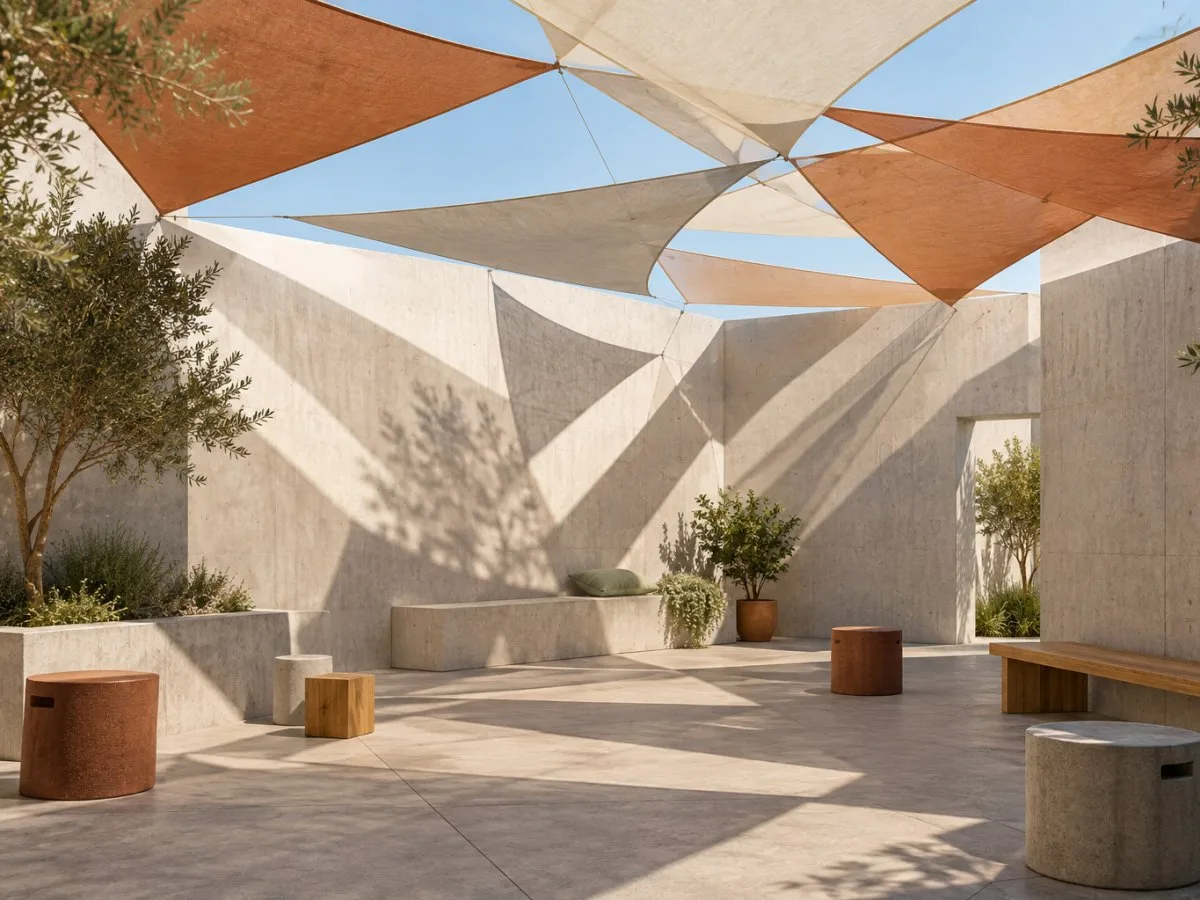
That decision changed the role of temporary architecture. Instead of treating the courtyard as a neutral support to be transformed, Holding Pattern approached it as a structure that could already shape the experience. The existing form became more perceptible through a canopy of ropes and sails; the space was defined from above, without a ground-level support system that would visually interfere with the courtyard.
A canopy that draws the space
The canopy provided shade while casting shifting geometric shadows across the courtyard’s interior and exterior concrete walls. Its intricate framework, described as resembling a stringed instrument, made the movement of light visible and extended the project’s presence toward the street: shadows on the exterior walls announced the installation to passersby.
In this way, the boundary between the enclosure and the city did not depend only on a constructed form. It was also created by changing effects of light as the sun moved. The canopy was climate infrastructure—it provided shade—and, at the same time, a temporary surface through which to perceive the courtyard differently. This reading does not require claims beyond what is documented: its dimensions, detailed materials, and degree of protection are not specified here.
The focus: gathering and participation
Movable benches and stools, wading pools, and Ping-Pong tables formed an important part of the intended experience. Attention shifted from the structure to interactions between visitors and to objects that could be rearranged. Rather than making the canopy the main destination, the design foregrounded everyday activities: sitting, playing, and sharing the space.
The movable furniture also made it possible to imagine the courtyard as less rigid than a plaza organized around a single use. No specific configuration needs to be assumed to understand that possibility: the movable elements could change position, while the enclosure and its canopy gave the whole a sense of continuity.
Two side courtyards, two treatments
The intervention did not apply a single solution to every adjoining space. The smaller side courtyard was lined with mirrors; the larger was filled with a dense urban wood. The contrast proposed different settings beside the main courtyard: a reflective surface in one case and a concentration of trees in the other.
The available description does not detail the arrangement of the mirrors or the species, number, or characteristics of the trees. It is therefore more precise to read these choices as spatial strategies—reflecting and creating density—than to assign them specific undocumented effects. Together, the side courtyards broadened the range of experiences without requiring the central canopy to resolve them all.
A life beyond the installation
The project incorporated furniture and trees that, according to the published proposal, would be donated at the end of the summer. This later use connected temporary design with the reuse of objects and materials useful to the surrounding community. Temporary architecture was not measured only by what happened during the exhibition: it also mattered that some of its components could continue to be used afterward.
Holding Pattern therefore brought together three scales of design: the courtyard’s pre-existing form, the canopy’s shade and patterns of light, and the objects that could accommodate activities and continue their lives beyond the installation. Its interest lies in the relationship between these scales, not in imposing an entirely new form. The result can be read as an intervention that made the site more visible, activated social uses, and considered the fate of certain elements once the summer had ended.
Holding Pattern was presented at MoMA PS1 from June 19 to September 19, 2011, as part of the New York edition of the Young Architects Program, an annual initiative of MoMA and MoMA PS1 dedicated to fostering design research and emerging talent.
At a glance
Scope
Editorial reading; does not constitute a site visit or technical assessment.
Sources and references
Young Architects Program 2011: Holding Pattern by Interboro Partners | MoMA ↗30/10/2026
New York / Young Architects Program ↗30/10/2026