





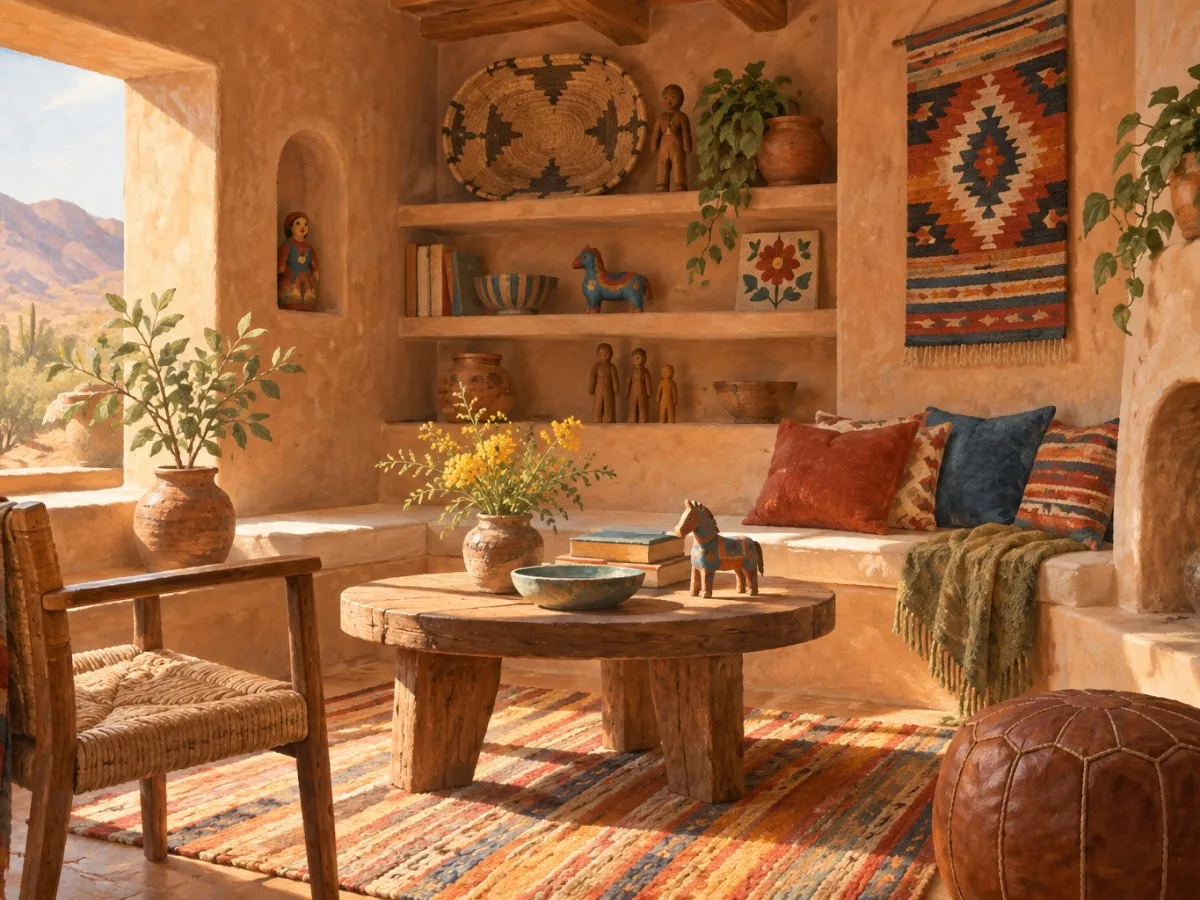
A home as a life’s work
Alexander Girard did not design objects alone; he designed ways of living. His homes, especially the one he shared with his wife, Susan, in Santa Fe, New Mexico, offer the most intimate account of his worldview. Unlike his commercial projects, these spaces did not seek static perfection but continuous evolution. Girard used his own home as a canvas for experimenting with light, texture, and cultural narratives, integrating his studio directly into the house so that making and everyday life became a single flow.
From classical Europe to the New Mexico desert
Girard’s path began in Florence, Italy, where, at 23, he created his first custom interior landscape in a studio apartment on the top floor of his parents’ home. His interest in craft was already evident: his teenage apartment included small African sculptures and Indian textiles, anticipating his later fascination with global cultures.
His move to Santa Fe in 1953 with his wife and two children, however, shaped his mature aesthetic. Having described Grosse Pointe, Michigan, as a “grey, conservative neighbourhood,” Girard was drawn to the American Southwest. The piñon-dotted high desert, the startling clarity of the light, and the pink and earthy tones of adobe construction offered a radical contrast to the tall, drab cities of the East. This new geography, together with local Native cultures and his own European childhood, became the foundation of his interior design.
The house as a museum in rotation
Girard did not design the Santa Fe house from scratch; he transformed the existing structures into a distinctive ensemble. Drawing on his experience in exhibition design, he turned his home into a constantly changing display. The rooms brought together his own designs, folk art, contemporary pieces, and antiques. The mix was not haphazard but curated: Girard believed that what already existed could serve as a starting point for developing his own interpretation.
The result was a series of warm yet sophisticated spaces that evolved with his discoveries and tastes. Integrating his studio was central to his philosophy. With his workspace attached to the home, he could experiment with ideas in his own interiors, display his changing collection of objects, and increase his productivity. His wife, Susan Girard, was an integral part of this process. An aesthete with a keen eye for art, fashion, and design, her personal style contributed greatly to the way their homes took shape.
Color and folk craft as a language
Girard’s fascination with folk art was not superficial. He saw folk art as an ancient global tradition that helped preserve cultures through works made for people rather than for mass production. This outlook was reflected in his home, where color was used freely, without the conventions of traditional schemes. Charles Eames, a close friend of the couple, once observed that, uninhibited by conventional color schemes, Girard used color in his home with the same lack of inhibition that characterized his approach to all his design.
Girard collected folk art from around the world, building a private archive in Santa Fe that is now part of the collection of the Museum of International Folk Art in Santa Fe. In his home, this art was not shut away in display cases but lived alongside everyday life. He juxtaposed the bold and the neutral, the rudimentary and the refined, the old and the new. Through this living collage, he transformed interior decoration into a modern art form.
Details that humanize a space
Details in Girard’s home revealed his attention to human scale and emotion. One notable example is the nicho—or nichos, as they are known in New Mexico—one of his favorite architectural features. In his second Santa Fe home, he created a custom cubby to house a diorama of a Russian church that he had designed and made himself. Inside the miniature interior, the figures of a grandmother and granddaughter looked up at the painted columns and ceiling. One particularly human detail was a special switch, placed low enough for a child to reach, that illuminated the small space. This combination of meticulous design and whimsical details became a hallmark of Girard.
Another example of his exploration of tools and materials is the Wooden Dolls. They grew out of experiments with a new band saw he had bought for his studio, and they never left his personal collection. The dolls show clear influences from folk art around the world: New Mexico kachinas, African ceremonial figures, Indian puppets, and Italian ceramics. Their faces express the full spectrum of human emotion, reflecting Girard’s interest in building bridges across cultures, economies, and languages through design.
Christmas as a ritual of connection
For Alexander Girard, the Christmas holidays were cherished and important rituals. Although he was not raised with a specific religious focus, he was inspired by traditional Christmas ceremonies that brought people together to celebrate life and creation. From his childhood in Florence, he remembered visiting hundreds of churches, sitting quietly, noticing the architecture, and lighting a candle. At Christmas, these visits became extraordinary, accompanied by the scent of pine branches and colorful nativity scenes.
Christmas in his Santa Fe home was a uniquely sensory experience. His granddaughter, Aleishall Girard Maxon, recalls the brass table covered with mysterious, shining objects that reflected the light of the warm fire; the scent of burning piñon sap; oatmeal and caramel cookies, thin as lace; colorful paper crowns found in foil-wrapped Christmas crackers; and candles on every surface. For Girard, Christmas was a time to honor ancient myths, stories, and symbols that were more about human connection than any particular dogma. Throughout his career, he returned again and again to the nativity scene, exploring different media, scales, and compositions, fascinated by its universal elements: the light of a star, the gift, the miracle of birth, and the creativity inherent in the story.
A legacy of continual experimentation
Girard’s homes were an extension of himself: of the way he saw and used color, pattern, and texture, and of how he made connections among many different cultures. They were not static museums but living spaces that changed over time. His legacy lies not only in the objects he designed but also in how he showed that design can be a way of life—open, inclusive, and deeply human.
Today, his granddaughter Aleishall Girard Maxon and nephew Kori Girard, who lead Girard Studio, work to preserve and share this vast legacy. Their work continues Girard’s tradition of seeing design not as an isolated discipline but as a way to connect with the world and with other people.
At a glance
Scope
Editorial reading; it does not constitute a visit or a technical assessment.
Sources and references
An Invitation to Alexander Girard’s Home | Official Vitra® Online Shop CH ↗24/10/2026 An Invitation to Alexander Girard’s Home | Vitra Magazine (2016)
The Holidays | Official Vitra® Online Shop ES ↗24/10/2026 The Holidays: Remembering Christmas in Alexander Girard’s House | Vitra Magazine (2017)
How Folk Art Becomes Design - and Vice Versa | Official Vitra® Online Shop US ↗24/10/2026 How Folk Art Becomes Design - and Vice Versa | Vitra Magazine (2018)