





Light is a defining factor in interior architecture, but it is not always abundant. North-facing rooms, narrow hallways and areas with small windows present both an aesthetic and a botanical challenge: how to bring in greenery without making a space feel oppressive or neglected. Choosing plants for these areas is not just about survival; it is also a design decision. Many popular houseplants originate on the floors of dense forests, where direct sunlight is scarce and ambient humidity is constant. This evolutionary adaptation allows them not only to survive in shade, but also to develop morphological features—rich colours, contrasting textures and architectural forms—that enrich an interior’s visual palette.
The logic of shade and natural light
A practical rule for assessing whether an indoor growing spot is suitable is this: if there is enough natural light to read a book comfortably, it is likely to suit most shade-loving plants. In contrast with sunny areas, where the main risks are rapid drying and leaf scorch, potting mix dries more slowly in dark spaces. This does not remove the need for regular watering, but it changes the maintenance routine. In the absence of intense light, plants can develop larger, thinner leaves to capture as many of the available photons as possible, creating greater visual density and a sense of lushness indoors.
Ivy: versatile structure
Ivy (Hedera helix) is often thought of as an outdoor plant, but its versatility makes it a useful feature in low-light interior design. It is a hardy species that tolerates both shade and occasional neglect. From a design perspective, its trailing habit suits hanging pots and high shelves, where it can create green cascades that soften the hard lines of architecture. Varieties such as ‘Midas Touch’ offer golden tones that draw the eye in dark corners, while others have textures and colours that add contrast to denser arrangements. Although ivy is often associated with air purification, its main benefits in the home are visual and related to wellbeing: it brings in an organic element that connects indoor spaces with nature.
Cast-iron plant: Victorian resilience
The cast-iron plant (Aspidistra) has a history linked to the Victorian era, when it was a standard houseplant able to withstand not only darkness but also indoor pollution from coal stoves and gas lighting. Although sources of pollution have changed, it retains a reputation for being exceptionally hard to kill. Its resilience makes it well suited to spaces that may receive little attention or have very low light levels. In contemporary design, the cast-iron plant has returned as a fashionable choice, particularly varieties with spotted or striped leaves, which add visual interest without requiring the delicate care of some other species. Its dark, leathery leaves provide an elegant, neutral backdrop that lets more colourful plants stand out.
Ferns: textural contrast
Ferns are classic choices for shady spots, both indoors and outdoors. The Boston fern (Nephrolepis exaltata ‘Bostoniensis’) is a notable example: its arching fronds of fresh lime green contrast pleasantly with the dark, leathery leaves of other shade-loving plants. Its intricate, delicate structure brings visual lightness that balances the density of more robust species. Fern care requires attention to moisture in the potting mix. If a watering is missed and some leaves drop, the plant will often grow back, suggesting some tolerance of fluctuations in care, provided regular watering resumes.
Begonias: colour takes centre stage
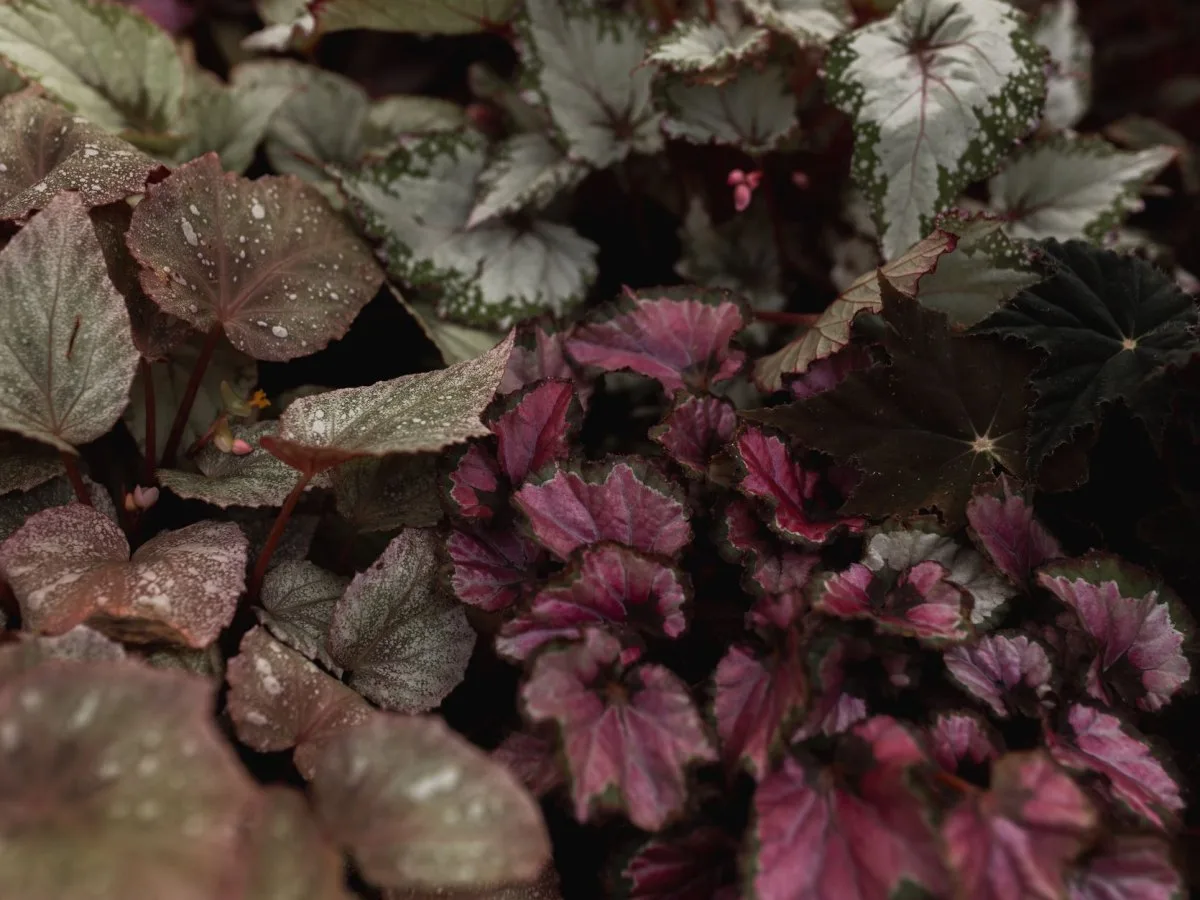
Begonias, which originate on the floors of dimly lit forests, are among the best options for bringing colour into dark rooms. Many varieties, particularly forms of Begonia rex, have leaves with bright swirls and stripes in shades of purple, pewter and green. This complex pattern acts like a work of natural art, capable of turning an empty corner into a focal point. The polka-dot begonia (Begonia maculata) makes a larger-scale statement, with spotted leaves and white flowers in summer. Choosing these plants allows you to play with an interior’s colour palette, using foliage as a decorative element with the qualities of textiles and colour.
Shade-loving orchids: understated elegance
For those who want flowers in spaces without direct sun, slipper orchids (Paphiopedilum) are a notable option. They are among the most shade-tolerant indoor orchids and are available in colours including green, purple, white and pink. Their unusual flowers make a strong statement and suit both traditional and modern settings. Some varieties also have attractive mottled leaves. Unlike other orchids that may need bright indirect light, these plants prefer shade in summer, although moving them to a brighter windowsill in winter is advisable to maintain their health. They add sophistication and an exotic touch without requiring very high light levels.
Golden pothos: a luminous touch
Golden pothos (Epipremnum pinnatum ‘Golden Pothos’) is an almost luminous plant that can brighten spaces without sun. Although it is not as shade-tolerant as the cast-iron plant or ivy, its vibrant foliage makes a strong impression. It can be grown as a trailing plant in a basket or trained up a moss pole, making it adaptable to different design schemes. Its fast growth and hardiness make it an effective way to fill empty spaces and add a dynamic element to an interior arrangement.
Rhipsalis: the jungle cactus
A cactus that loves shade may sound contradictory, but Rhipsalis shows that some cacti prefer life away from the spotlight. Native to shady rainforests, this cactus is hardy and tolerates considerable shade. Most varieties are spineless, making it one of the least cactus-like cacti. Its delicate, pendulous form is best appreciated in hanging pots, where it can create a suspended effect that adds depth and movement to a room. It is an ideal choice for anyone who wants the look of succulents without their need for intense light.
Other plants recommended for shade
Beyond the featured species, many other plants are recognised as suitable for low-light spaces. Many have received the Award of Garden Merit, a distinction indicating their performance and reliability in cultivation. Additional options include:
- Monstera deliciosa: Known for its large, perforated leaves, this foliage plant brings a tropical, structural look.
- Epipremnum aureum: Similar to golden pothos, it is a hardy, easy-to-care-for vine.
- Dieffenbachia ‘Camille’: Its variegated foliage adds visual interest.
- Pilea cadierei: Known for its rounded, silver leaves, it brings a modern touch.
- Sansevieria trifasciata: An upright-growing succulent that is extremely tolerant of shade and drought.
- Chlorophytum comosum ‘Vittatum’: A trailing plant with narrow, variegated leaves.
- Aglaonema ‘Silver Queen’: A foliage plant with silver and green tones that adapts well to low light.
- Peperomia obtusifolia: A compact, easy-to-manage succulent with thick, glossy leaves.
- Zamioculcas zamiifolia: Known for its elegant foliage and resilience in challenging conditions.
- Syngonium podophyllum: A vine with arrow-shaped leaves that change colour as they mature.
- Begonia masoniana: A foliage begonia with a distinctive pattern of silver spots.
- Cissus antarctica: A fast-growing vine that can add a dense green element.
- Ficus benjamina: An indoor tree that can bring an arboreal presence, although it may be sensitive to changes in location.
- Maranta leuconeura var. kerchoveana: Known for its prayer-like movement at night and colourful leaves.
- Lapageria rosea: A pink-flowered vine that can provide a floral accent in shady spaces.
- Asparagus densiflorus ‘Myersii’: A foxtail fern that adds fine, delicate texture.
- Goeppertia roseopicta: A foliage plant with a pattern of pink and silver spots.
- Nephrolepis exaltata ‘Bostoniensis’: The Boston fern mentioned above, a classic choice for shady areas.
- Maranta leuconeura var. erythroneura: Another maranta variety, with red veins and green leaves.
- Selaginella kraussiana: A ground-covering plant that can be used as a carpet or in hanging pots.
- Chlorophytum comosum ‘Variegatum’: Another spider plant variety with variegated leaves.
- Begonia ‘Silver Spirit’: A foliage begonia with silver and green tones.
- Rhipsalis teres: A variety of rhipsalis with delicate, cylindrical stems.
- Begonia rex: The angel-wing begonia, the basis of many foliage varieties.
- Tradescantia fluminensis: A foliage plant with silver and green tones that adapts well to shade.
- Spathiphyllum wallisii: Known as the peace lily, it is one of the few shade-loving plants that flowers regularly.
- Aechmea fasciata: A bromeliad that can tolerate shade and brings an architectural form.
- Soleirolia soleirolii: A small, dense ground-covering plant that can be used as an accent.
- Plectranthus verticillatus: A foliage plant with a pattern of silver spots.
- Philodendron scandens: A fast-growing vine that can add a dense green element.
Design and wellbeing considerations
Bringing these plants into interior design goes beyond simple decoration. Greenery in low-light spaces can contribute to mental wellbeing by providing a connection with nature in urban settings. The range of textures, from the leathery leaves of the cast-iron plant to the delicate fronds of ferns, allows you to create arrangements that are visually rich and interesting to touch. The colours of begonias and ivy can balance cool or neutral palettes, adding warmth and vitality. Plant forms—trailing, upright or bushy—can help define zones and guide the eye through a space. Choosing plants for dark spaces is a design decision that prioritises resilience and beauty in limited light, transforming a potentially neglected area into a welcoming green retreat.
Conclusion
Low-light spaces are not a limitation but an opportunity to explore the diversity of plants that have evolved to thrive in shade. From the resilience of the cast-iron plant to the vibrant colour of begonias, these species offer practical and aesthetic possibilities for interior design. The key is to understand each plant’s needs and use its morphological features to create arrangements that are visually appealing and emotionally satisfying. Choosing plants for these spaces is an investment in the quality of the indoor environment, creating a home that is not only functional but also a calm retreat filled with natural beauty.
At a glance
Scope
Editorial reading; it is not a visit or a technical assessment.
Sources and references
Houseplants for dark and shady rooms ↗24/10/2026 �Houseplants for dark and shady rooms,” Royal Horticultural Society.
Best houseplants for sunny rooms ↗24/10/2026 �Best houseplants for sunny rooms,” Royal Horticultural Society.
Choosing the Best Houseplants | RHS Advice ↗24/10/2026 �Choosing the Best Houseplants | RHS Advice,” Royal Horticultural Society.