





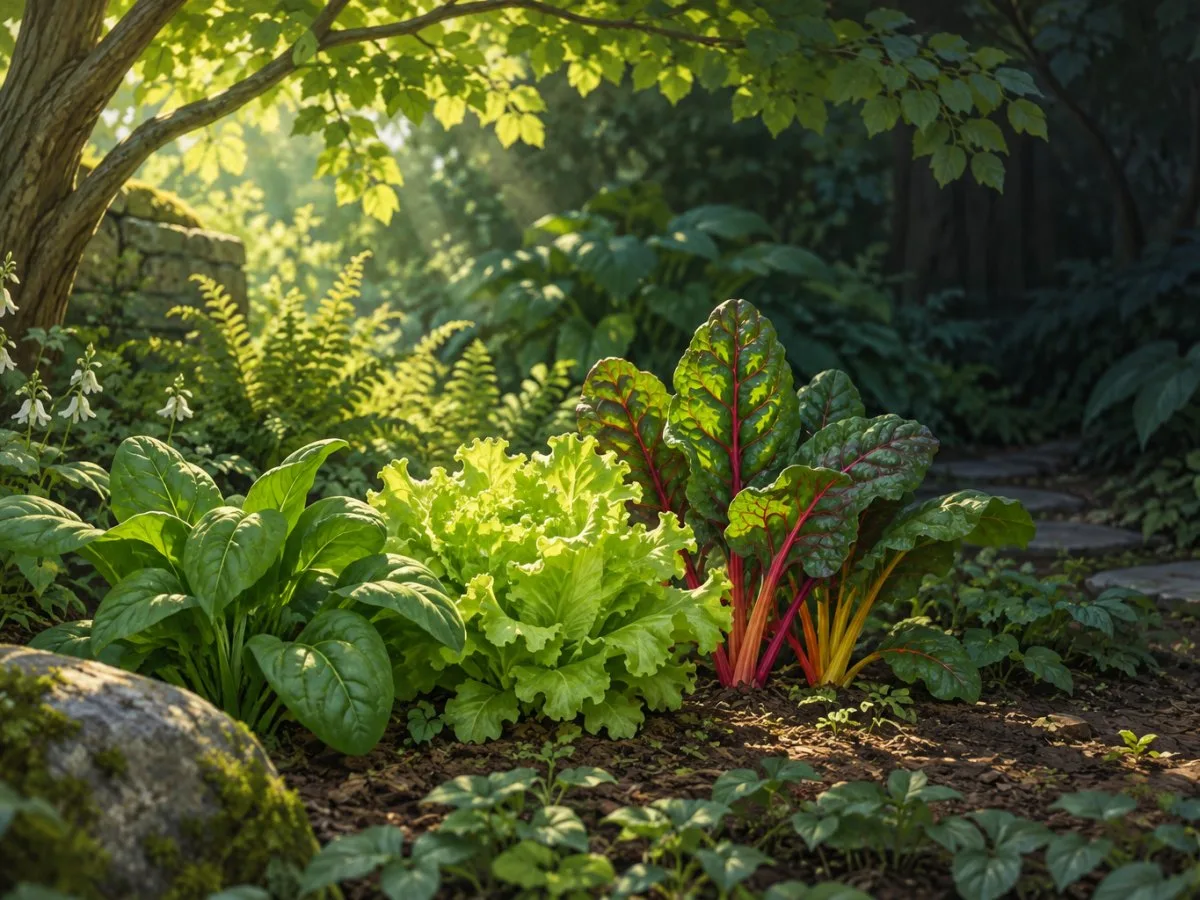
Shade is not the same in every corner
A garden with only a few hours of direct sun does not have to be unusable. However, crop choice depends on how much light reaches the space, for how long, and on the condition of the soil. Shade reduces the light available for photosynthesis and can limit growth and production; in a very dark place, especially if it is also dry, the options are few. By contrast, some leafy vegetables, herbs and fruit crops tolerate partial or dappled light.
The source of the shade matters too. A building blocks light, while the roots of trees and shrubs may compete for water and leave the soil dry. That is why two equally shady spaces can offer different conditions: a wall may create a sheltered, dry place, while beneath a tree there may be both less light and root competition.
Before choosing plants, observe the space at different times of day. Midday light is more intense than morning or afternoon light, so counting only the hours of sun without considering when they occur can lead to a misleading classification.
A practical guide to describing light
The following categories describe exposure in midsummer; they are not a promise of yield. Dappled shade means filtered or reflected light, for example beneath an open tree canopy.
| Condition | General description | What it means for growing |
|---|---|---|
| Full sun | More than six hours of direct sun a day | The most favourable exposure for crops that depend on sun; not essential for all edible leaves. |
| Partial shade | Three to six hours of direct sun a day | Can allow harvests of several shade-tolerant vegetables, especially if the site gets some midday sun. |
| Moderate shade | Two or three hours of direct sun a day | Limits the options; tolerant crops may grow, often with lower yields. |
| Light shade | Open to the sky, but screened from direct sun by an obstacle | May suit crops that do not require full sun, although growth or flowering may be reduced. |
| Dappled shade | Diffuse or filtered light throughout the day | May suit plants adapted to open woodland conditions, but competition for water remains important beneath trees. |
| Deep shade | Less than two hours of direct sun, often beneath dense canopies or beside buildings | The most limiting condition, especially if the soil is dry; few edible plants thrive there. |
These categories describe different conditions, not a perfect scale. Light shade, for example, does not necessarily mean three hours of direct sun: a site may be open to the sky yet screened from the sun by a wall or a group of trees.
Edible leaves: the most flexible group
Leafy crops are often the most practical choices for corners in partial shade. Unlike many fruiting crops that need greater exposure, several leafy vegetables can grow with limited light. Cooler conditions can also benefit some species: spinach and lettuce can turn bitter in sun and heat, while shade can keep plants cooler and delay premature flowering.
Chard, spinach, lettuce and other salad leaves are among the relatively light-tolerant options. Swiss chard with yellow stems combines edible leaves with ornamental value, so it can be incorporated into a border alongside decorative plants. Winter spinach and perpetual chard offer another advantage: they can provide harvests over an extended season, although the actual duration will depend on growing conditions.
Perpetual chard can be direct-sown in spring in a shady spot. A second sowing in midsummer or shortly afterwards is also described as a way to extend the harvest from autumn until late winter or early spring. Harvest by picking individual mature leaves or cutting sections of the plant. Spring-sown spinach intended for a summer harvest can benefit from some shade, which helps keep it cool and delay flowering and seed formation.
Shade does not make every corner a good seedbed. Available light must be sufficient for plants to establish, and deep shade remains unsuitable. If a place receives only scant, diffuse light, it is more realistic to expect limited growth than an abundant harvest.
Herbs that can benefit from cooler conditions
Coriander can struggle in summer when intense sun and heat encourage it to flower and set seed too early. A cool, shady location can help maintain leaf production. One suggested approach is to sow it beneath a row of runner beans planted in stages, so the companion plants provide shade and staggered sowings make leaves available at different times.
Sweet cicely, also called sweet chervil, is a perennial with delicate foliage that can grow in dappled shade. Its leaves have an aniseed flavour, and its green pods can be used to sweeten rhubarb dishes naturally. The leaves can also be added to salads and drinks. Its flowers provide early food for pollinators. It is a tall plant, so consider the space it occupies before placing it in a narrow border.
These possibilities illustrate a useful distinction: shade can moderate heat, but it does not replace each crop’s needs for light, water and space. The result depends on the microclimate as well as the species chosen.
Fruit for partial shade and vertical structures
Some small fruit trees and berry-producing shrubs tolerate partial shade, especially in a sheltered spot. Not all are suited to dappled or deep shade: shifting light and root competition remain decisive factors.
Berry shrubs and plants
Redcurrant ‘Rovada’ can be grown in a sheltered, partially shaded place. As well as growing as a bush, it can be trained as a fan, espalier or cordon, including against a north-facing wall. These forms make use of vertical surfaces where ground space is limited; they do not, however, remove the need for enough light to produce fruit.
Chilean guava is an evergreen shrub originating in the understorey of South American temperate forests. It can be shaped into a low hedge or trained against a wall. It is self-fertile, so one plant can produce berries. The fruit ripens from late summer and is described as tasting of strawberry and pineapple. Young plants can spend the winter in a sheltered place; established plants may benefit from a bark mulch in autumn to help retain moisture during summer.
Tayberry, a raspberry-blackberry hybrid, is a vigorous plant with arching canes. Its strong roots can seek moisture in drier, shady places, and the canes can be tied to a fence or wires to use vertical space. To harvest the fruit at its sweetest, wait until it reaches its deepest red. Its vigour makes it important to plan where it will grow and how the canes will be trained.
Japanese wineberry produces arching stems and dark red fruit that ripens in late summer. It can grow in the ground and tolerates partial shade; its long canes are also suitable for training against walls or fences. It bears white flowers in early summer, and its red stems add winter interest. The plant is described as spreading considerably, so it is not a compact choice without training or sufficient space.
Alpine strawberries offer a smaller alternative for shady edges, gaps at the front of borders and containers. The ‘Golden Alexandra’ form produces aromatic red fruit and can bear from June until early autumn. Unlike large-fruited garden strawberries, it tolerates partial shade and can be grown in hanging baskets or window boxes.
Rhubarb: tolerance, not absolute shade
Rhubarb can grow in partial shade, as a woodland-edge plant, but deep shade can reduce its vigour. Its large foliage also has a marked visual effect: the broad, rounded leaves reflect available light and can bring presence to a dim corner. It is worth distinguishing a lightly shaded place from one beneath a dense canopy, where growth may be unsatisfactory.
Crops that need more caution
Fruiting vegetables that need warmth and prolonged exposure, such as tomatoes and aubergines, may struggle without sun for much of the day. They are not the first choice for a very shady corner. By contrast, some tolerant vegetables—including chard, kale, peas, runner beans, lettuce and spinach—can grow in light or partial shade. Moderate shade narrows the options further, and deep shade should not be confused with a simply cool exposure.
Brussels sprouts can grow in partial or light shade, although deep shade should be avoided. The ‘Igor’ cultivar produces tall stems and may need support if you want to keep the plants uniform; it can be harvested through winter. It is an example of a crop that tolerates a less sunny exposure, not a plant indifferent to light.
Design the garden for the site, not just the plant
Shade can help distribute uses in a small garden. Tolerant leafy vegetables and herbs can occupy cool spaces, while plants more dependent on sun can be reserved for open areas. Fruit crops that can be trained vertically can make use of fences and walls, and alpine strawberries can be grown along edges or in containers.
The design must also respond to soil conditions. Beneath trees, shade often coincides with root competition and dryness; near a wall, a spot may be sheltered from rain and dry out. In a dry, shady corner, edible crops suited to partial shade will not necessarily thrive. If the soil is very dry, remains very wet for extended periods, or the shade is deep, plant choice should be more restricted.
The best decision starts with observation: does the site receive direct sun, and at what time? Is light filtered through branches, or is the sky blocked? Are there trees whose roots may compete for water? Is there a wall or fence that could support a berry plant? These questions help distinguish a place suited to edible leaves from one where it may be better to prioritise ornamental plants that tolerate shade.
At a glance
Scope
Editorial reading; this is not a site visit or a technical assessment.
Sources and references
Best crops for shady garden spots ↗22/10/2026
Shade Gardening Tips and Plant Ideas | RHS Advice ↗22/10/2026
Plants for dry, shady spots ↗23/10/2026