





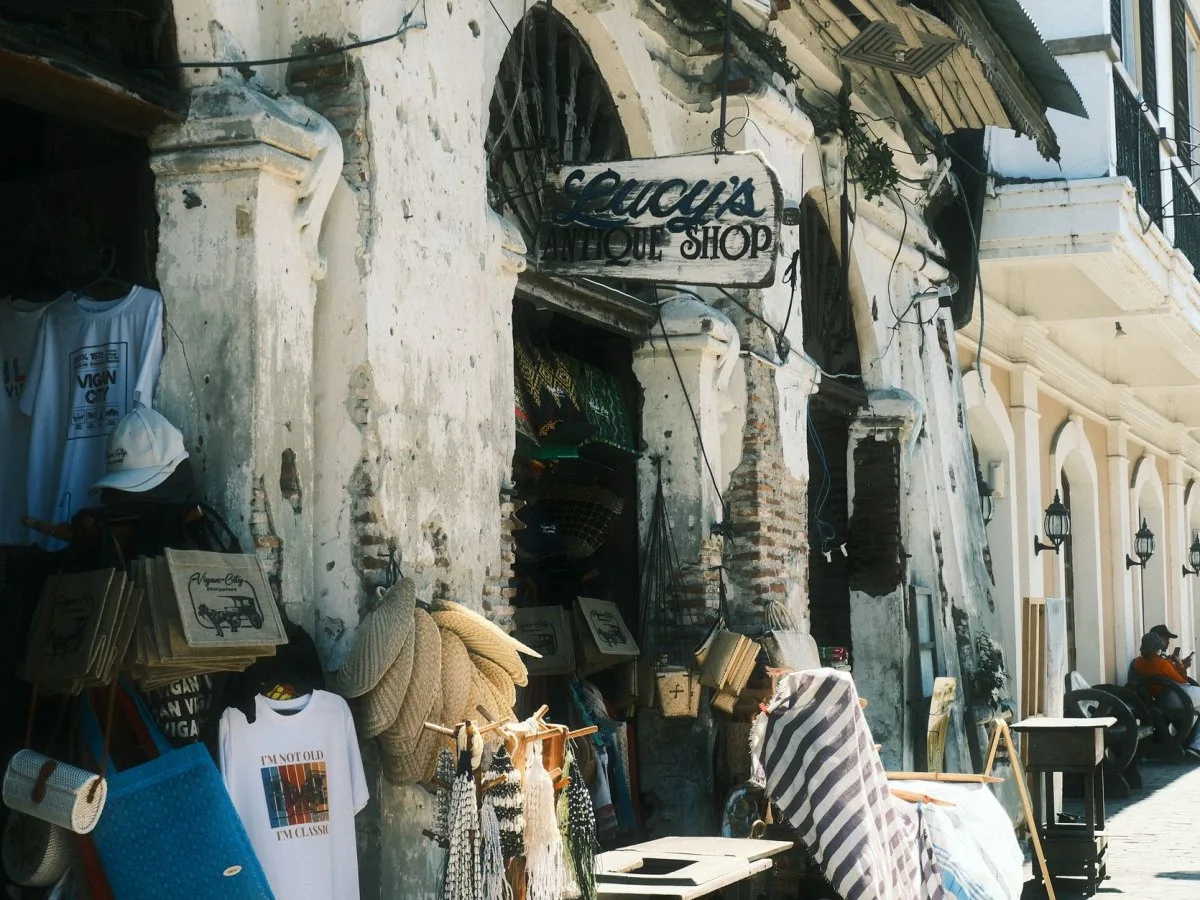
A city shaped by cultural crossings
In Vigan, heritage is not limited to individual buildings: it is also found in the relationship between streets, plazas, homes, and the uses that keep those spaces part of urban life. Founded in the 16th century and inscribed on the World Heritage List in 1999, the Philippine city is an exceptionally intact example of a planned trading settlement established during the Spanish colonial period in Asia.
Its townscape brings together elements from different origins. European colonial planning meets Asian building traditions and influences from the Philippines, China, and Mexico. The result is not a sum of separate styles, but an urban fabric in which these references coexist and transform one another.
The grid and the two plazas
The historic core retains a grid of streets that opens onto two adjoining plazas: Plaza Salcedo, the longer arm of an L-shaped space, and Plaza Burgos, the shorter one. St. Paul’s Cathedral, the Archbishop’s Palace, City Hall, and the Provincial Capitol are grouped around the plazas, giving them a civic presence as well as a religious and administrative one.
The grid recalls planning models used in cities of the Spanish Empire, but Vigan’s ensemble has distinctive characteristics. In the historic district known as Mestizo, Chinese, Ilocano, and Filipino influences temper that tradition. The urban form makes this blend legible at an everyday scale: not only in the appearance of buildings, but also in the way homes, commerce, and public space connect.
Houses that combine living and commerce
The historic district preserves buildings arranged along a network of streets. Many traditional houses have two storeys and combine brick and wood beneath steeply pitched roofs. On the ground floor, Chinese merchants conducted business in shops, offices, and storerooms; living quarters were on the upper floors. This arrangement brought work and domestic life together within a single structure.
The upper-storey windows, made of kapis-shell panels framed in wood, could slide open to improve ventilation. More than an ornamental detail, they are part of an architecture that responds to local uses and conditions through specific materials and building solutions.
Although Vigan retains much of its historic character, not all its houses have remained intact. Some interiors have been divided into smaller apartments or adapted for commercial uses; other structures have been altered, abandoned, or allowed to deteriorate. Modern materials have also been used when traditional resources such as wood and lime are scarce. The continuity of the townscape therefore depends as much on the form of its streets as on decisions affecting each building.
Conservation also means management
Conservation in Vigan has been organized as an urban and social task as well as an architectural one. After the city was inscribed on the World Heritage List, the local government and various stakeholders formulated an action plan linking heritage protection with the city’s development. Its areas of work included planning for the historic area, rules for interventions in buildings and open spaces, and coordination of decisions through local conservation bodies.
The framework also addressed issues that are not strictly monumental: traffic in the historic centre, training in traditional crafts, and the participation of owners, residents, educational institutions, and businesses. Conservation rules initially met opposition from some property owners because of restrictions on their properties. This tension highlights an essential aspect of any inhabited historic centre: protecting a place’s character requires negotiating how its buildings can continue to be used.
Training in traditional building techniques, alongside the transmission of crafts such as weaving and pottery, connects the conservation of physical fabric with knowledge that is also part of heritage. Street signs made from local clay and the restoration of public spaces are examples of interventions intended to make the character of the place recognizable without reducing it to a collection of façades.
Heritage within everyday life
The strategy developed for Vigan was not limited to the historic district. It included community needs such as access to clean water, waste management, health, and sanitation, as well as roads to improve access to villages and their economic activities. The underlying idea was that conservation and tourism should not be separated from the living conditions of the people who call the city home.
Education about local history and culture, festivals, and the participation of community organizations are also part of this approach. In this view, heritage consists not only of preserving old materials; it also includes practices, skills, and forms of belonging that are passed on and renewed.
The growth of tourism and the economy, however, brings new challenges. Increased traffic can put pressure on the centre, and the use of historic properties can conflict with residents’ needs and conservation requirements. Some houses continue to deteriorate. The available documentation does not point to a single solution; rather, the case shows that preservation must be reconsidered alongside urban change and community needs.
Reading the whole
Vigan is best understood by looking at the relationships between its parts: the grid and plazas, houses that combine commerce and residence, materials and crafts, and the institutions that organize change. Its architectural interest does not lie in an unmoving image of the past, but in the way a historic city maintains—and negotiates—the coexistence of conservation and everyday use.
At a glance
Scope
Editorial reading; it does not constitute a visit or a technical assessment.
Sources and references
Historic City of Vigan ↗27/10/2026 UNESCO World Heritage Centre, Historic City of Vigan.
Guide 1 – Case Study: Historic Town Of Vigan (Philippines) ↗27/10/2026 UNESCO World Heritage Centre, Guide 1 – Case Study: Historic Town of Vigan (Philippines).
Historic City of Vigan ↗27/10/2026
Historic City of Vigan ↗27/10/2026
Historic City of Vigan ↗27/10/2026
Conservation as a driver for development: the case of Vigan (Philippines) ↗27/10/2026 UNESCO World Heritage Centre, Conservation as a driver for development: the case of Vigan (Philippines).