





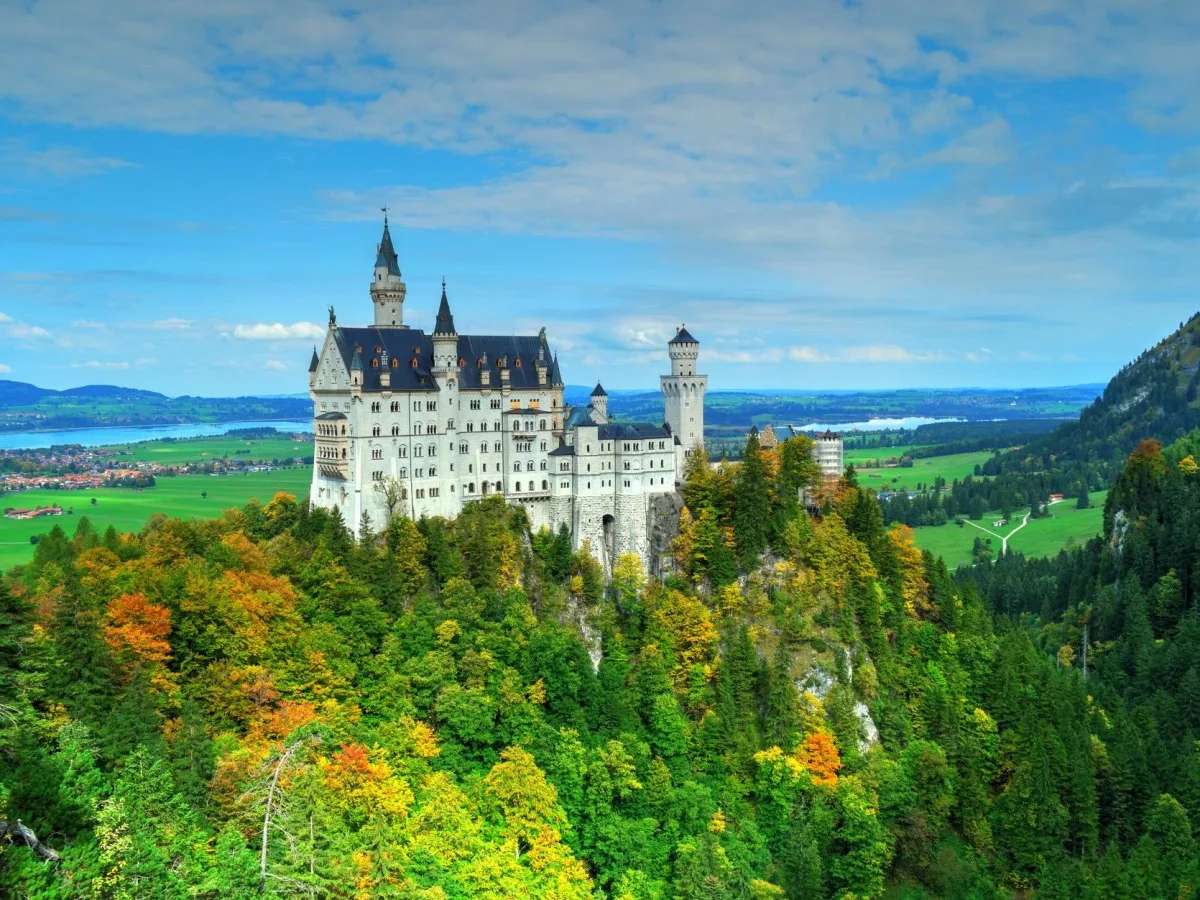
Four residences, one artistic vision
Between 1868 and 1886, during the reign of Ludwig II of Bavaria, four palace complexes were built in the Bavarian Alps and their foothills: Neuschwanstein Castle; Linderhof Palace, with its park and garden; the King’s House on Schachen; and Herrenchiemsee New Palace, with its gardens. Conceived as private residences and places of retreat, they were intended for more than domestic use: they were meant to make the enjoyment of art and the appreciation of beauty possible.
Their design turns that intention into a visual experience. The buildings and their settings stage poetic, imagined worlds, drawing on Wartburg, Versailles and Richard Wagner’s operas. German fairy tales also form part of this landscape of inspiration. The result is not a uniform style but a combination of historicism and eclecticism, characteristic of an era that revived and blended earlier architectural languages.
Landscape as part of the design
Location is inseparable from the architecture. The four complexes stand in Alpine and foothill landscapes noted for their natural and aesthetic qualities; their deliberately secluded locations and relationship with their surroundings contribute to a sense of retreat. In this reading, gardens, parks and sites are not a backdrop: they are part of the composition through which each residence creates its own world.
The series also shows how architecture can shape the way a place is seen. Theatrical effects, sumptuous ornament and cultural references turn the spaces into a stage set. This is not a description of how each interior is experienced today, but an interpretation of the artistic purpose attributed to the complexes: to make each residence a total work of art in which architecture, decorative arts and landscape are perceived as related parts.
Art, craftsmanship and technical possibilities
The ambition to create total works of art—Gesamtkunstwerke—brought artists and craftspeople together and made use of the technical possibilities available in the 19th century. The varied forms and appearances of the four complexes show that the unity of the project did not depend on repeating a single architectural solution. Its coherence lay in the vision: combining beauty, scale, luxury and visual effects to give material form to imagined worlds.
This relationship between imagination and technology helps explain why the palaces are regarded as more than picturesque buildings. Taken together, they express architectural trends popular in the second half of the 19th century and demonstrate notable artistic and technological skill. Their richness of style does not erase the differences between the sites; it makes those differences part of the character of the series.
From private residences to public heritage
The complexes opened to the public shortly after Ludwig II’s death in 1886 and are now preserved as museums. Their use and meaning have changed: residences conceived for private retreat have become places of cultural and heritage interest. Even so, the design, historic materials and layout of gardens and parks retain traces of the original intention.
The World Heritage inscription took place in 2025, following a decision by the World Heritage Committee. Protection and conservation fall within a Bavarian institutional framework; management covers buildings, structures, parks and gardens, as well as the landscapes surrounding the complexes. The decision also recommends developing an overall visitor strategy to address the effects of mass tourism and to involve local communities and authorities connected with the protected settings.
Reading the complexes as a whole
Seen as a series, Neuschwanstein, Linderhof, Schachen and Herrenchiemsee express an idea of residence as both refuge and image: secluded spaces that also communicate an artistic vision through historical styles, literary and musical references, contemporary techniques and natural settings. Their interest lies both in the distinctiveness of each complex and in how, together, they document 19th-century historicist and eclectic architecture.
At a glance
Scope
Editorial overview; not a visit or a technical assessment.
Sources and references
The Palaces of King Ludwig II of Bavaria: Neuschwanstein, Linderhof, Schachen and Herrenchiemsee ↗31/10/2026
47 COM 8B.24 - Decision ↗31/10/2026
UNESCO World Heritage Centre - Document - Neuschwanstein Castle: Singers' Hall ↗31/10/2026