





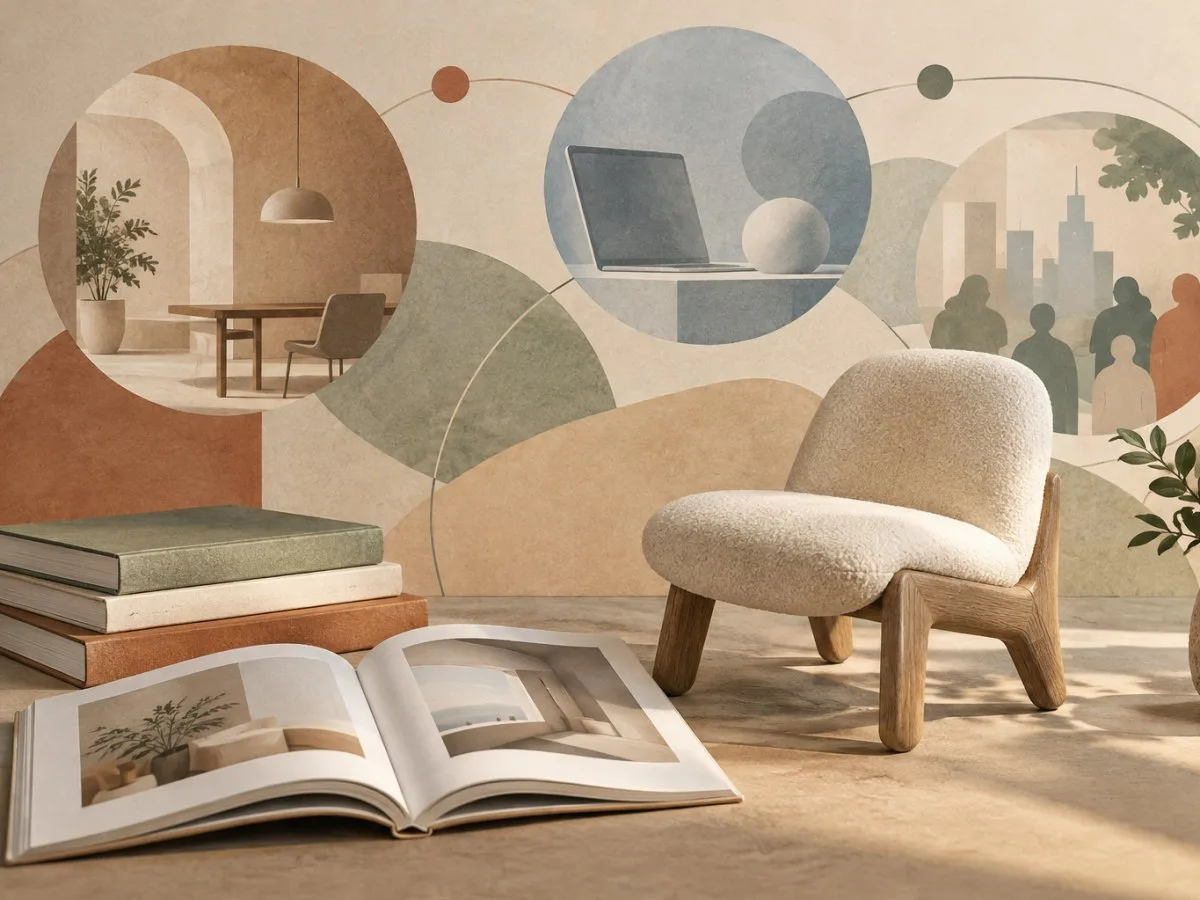
The Vitra Design Museum Library is designed as a research space for design and architecture. It specializes in furniture design and its influence on interior architecture from the beginning of the industrial age to the present. Its holdings also cover publications on the applied arts, photography, urban planning, the humanities, and the social and applied sciences.
A collection that puts objects in context
The library brings together more than 7,000 volumes on open-access shelves and an extensive range of international periodicals dating back to the 1950s. These materials provide documentary resources for preparing exhibitions and projects, and for documenting and contextualizing objects in the museum’s collection and archives.
This connection between books, objects and documents places the library within a broader research infrastructure. The museum’s collection focuses on industrial furniture and lighting, supplemented by groups of objects such as cutlery, consumer electronics and architectural models. Its archives preserve, among other materials, company publications, brochures, posters, patents and drawings. The library contributes another kind of context: publications make it possible to relate objects to the ideas, practices and social fields that run through design history.
From research to exhibition
The library’s holdings support the development of new exhibitions and projects. This role takes on meaning alongside the variety of the collection, which ranges from furniture from different periods of industrial design to lamps, prototypes and experimental objects. At the Vitra Schaudepot, a changing selection of more than 400 key pieces of modern furniture design spans the 19th century to the present; the institution also describes this space as a place of research.
The relationship can be understood as a cycle: objects raise questions; books and periodicals offer material for placing them in context; and this work can inform new presentations and projects. This is an interpretation of the library’s institutional role, not a claim that every object or exhibition is studied in the same way.
A reference library, not a lending library
The library does not lend its materials and is open to the public by appointment. The available information lists weekday hours of 9 a.m. to noon and 1 p.m. to 5 p.m., and says that visits must be arranged by email. The online catalogue allows users to search the library’s holdings.
Public access does not make it any less specialized: access requires an appointment, and the materials are intended for use on site. The library therefore combines research-oriented holdings with a regulated form of public access rather than operating as a general lending library.
Reading design in context
The library shows that studying design involves more than looking at the form of a chair or a lamp. Its scope includes publications on interior architecture, photography, urban planning and the social sciences, as well as documents connected with objects and the histories of their designers. Together, these materials make it possible to approach design as a practice situated within relationships among objects, spaces, technologies and society.
The published information does not detail how each research visit is organized or which materials are available for a particular question. The library is therefore described here in terms of its documented scope and function, not on the basis of a visit or an evaluation of its services.
At a glance
Scope
Editorial overview; not a visit or technical evaluation.
Sources and references
Library ↗31/10/2026
Collection ↗31/10/2026
Vitra Schaudepot ↗31/10/2026