





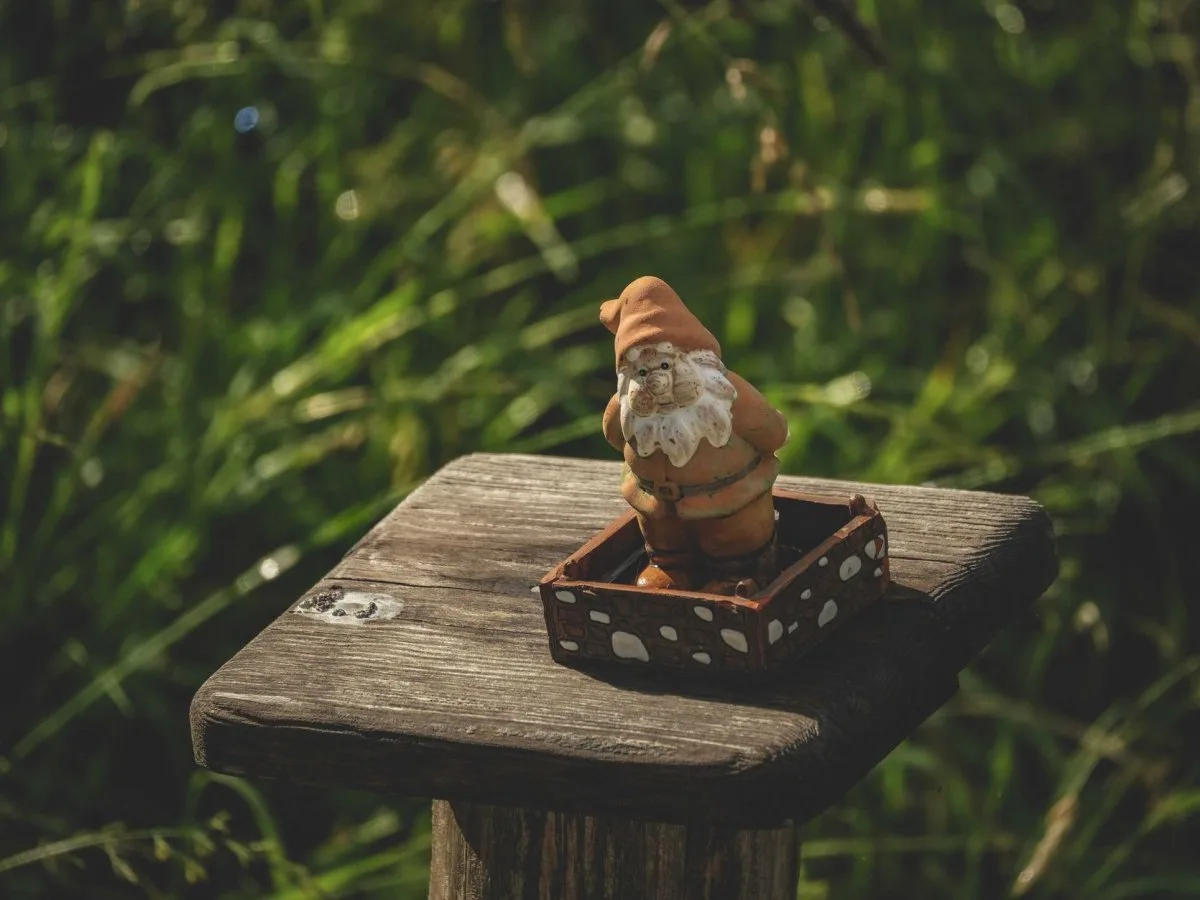
The everyday object as a mirror of change
The contemporary domestic interior has undergone profound change over the past two decades. Objects that once defined life at home, such as the television, telephone and bed, have seen their functions, presence and meanings shift. In this context, the garden gnome emerges not as a central feature of indoor life, but as an object that engages with outdoor spaces and with how we understand domesticity.
The Design Museum’s Home Futures exhibition invites reflection on these changes through essays by guest authors. These texts take stock of how the domestic interior has changed, asking what has happened to objects that were once indispensable. Although the garden gnome is not an indoor object, it offers a starting point for exploring how the boundary between domestic and outdoor space has become less distinct.
Domesticity beyond the walls
Traditionally, the home’s interior was defined by functional and symbolic objects: the television as an entertainment hub, the telephone as a means of communication, and the bed as a place of rest. Yet digitalisation and the reconfiguration of spaces have shifted these functions. Screens have entered every corner, and communication has become mobile and ubiquitous. In this setting, the garden gnome, an object that lives outdoors, reminds us that domesticity is not confined to the four walls of a house.
The garden, and by extension the gnome that inhabits it, represents an extension of the home into the outdoors. It is a space where domesticity takes a different form: expressed not through functionality, but through aesthetics, personalisation and identity. The gnome in particular has no clear practical function, yet it communicates something about the person who places it there: their sense of humour, their relationship with nature, and their desire to personalise a space that is, in theory, public or semi-public.
The gnome as an object of identity
Over recent decades, interior design has evolved towards greater personalisation. Homes are no longer defined by a single style, but by a collection of objects that reflect the identities of their inhabitants. Although it is not an indoor object, the garden gnome fits into this way of thinking. It is chosen, placed and displayed, communicating something about its owner. In this sense, the gnome becomes an object of identity, like a painting on the wall or a sofa in the living room.
The Home Futures exhibition explores how some of the most innovative and thought-provoking designs of the past twelve months, across fields such as fashion, architecture, digital design, transport, product design and graphic design, reflect these trends. Although the garden gnome is not an avant-garde object, it benefits from this logic: it has reinvented itself, moving from trivial decoration to a symbol of contemporary domesticity—more flexible, more personal and more connected to the outdoors.
The boundary between domestic and outdoor space
The transformation of the domestic interior has also involved redefining the boundary between indoors and outdoors. Balconies, terraces and gardens have become extensions of the home: spaces for eating, working and socialising. In this context, the garden gnome is not merely a decorative object, but an element that marks the transition between domestic and outdoor space. It inhabits the boundary, belonging to both worlds and reflecting the fluidity of contemporary domesticity.
Through its programme of temporary exhibitions, the Design Museum offers opportunities to explore the present and future of design. Home Futures is an example of how design can be a tool for reflecting on changes in everyday life. Although the garden gnome is not the exhibition’s central object, it becomes a symbol of these changes: by inhabiting the boundary between indoors and outdoors, it invites us to reconsider what it means to be domestic in the age of screens.
At a glance
Scope
Editorial reading; not a visit or a technical assessment.
Sources and references
The garden gnome ↗25/10/2026
Home Futures In-Depth ↗25/10/2026
Exhibitions ↗25/10/2026