





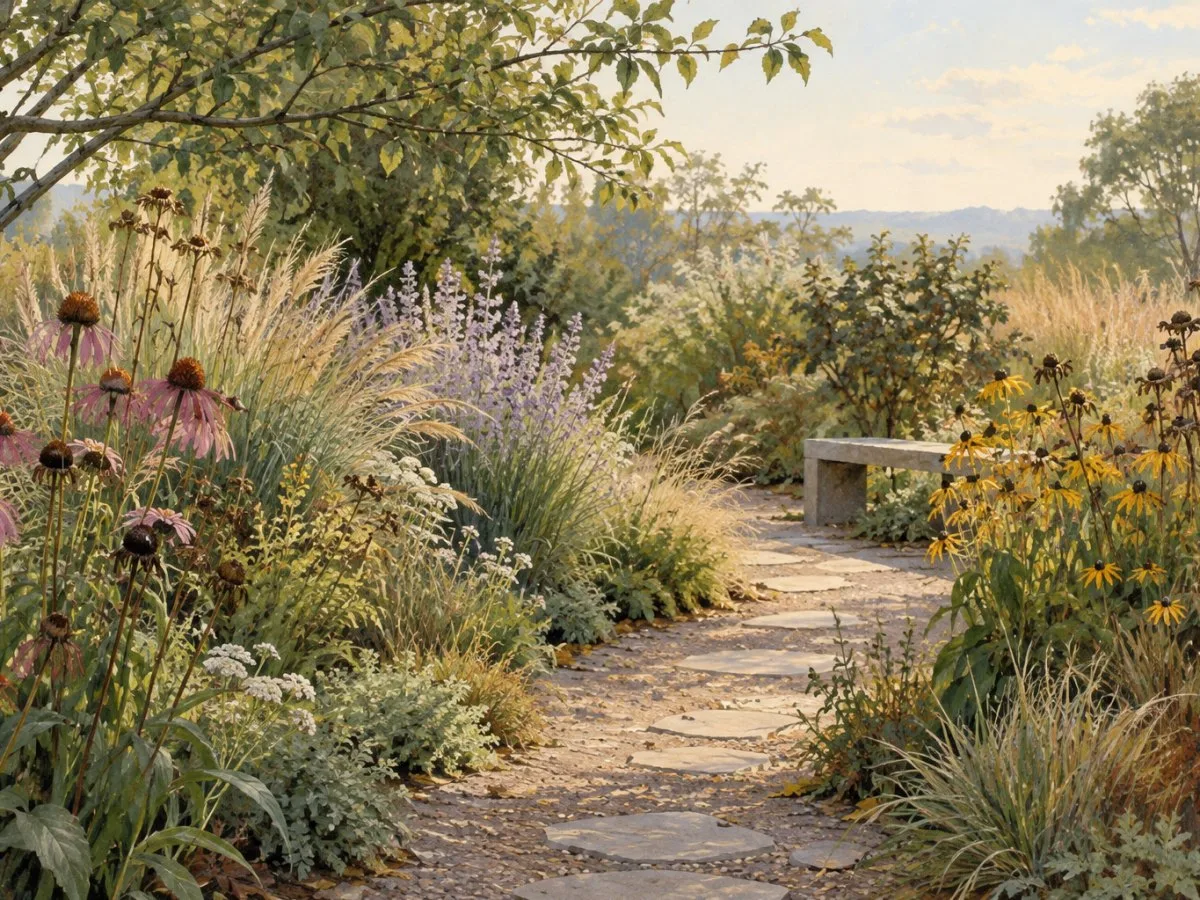
A garden may seem like a place set apart from ordinary life, but it is never entirely outside it. Someone chooses what to plant, where to open a path and what the space will look like. Even an appearance of spontaneity can result from deliberate composition. A garden therefore works as an interface: it brings people into contact with nature while making human ideas about nature visible.
A designed landscape, even when it looks free
The form of a garden reveals different ways of relating to living things. It can arrange plants with precision or suggest that they have grown without intervention. Neither appearance is neutral: both depend on decisions about form, care and the degree of control.
Piet Oudolf’s garden on the Vitra Campus in Weil am Rhein offers an example of this tension. Its landscape, composed of perennials and grasses and described as ever-changing, was conceived to transform with the seasons. The impression of free-growing nature does not remove the planning: the composition is arranged so that its relationships and contrasts evolve over time.
This combination of intention and change challenges the idea that design means reaching a final, perfect form. In a garden, the result does not remain fixed. Growth, flowering, withering and renewal are all part of the experience. Design establishes conditions; living things and time alter what happens next.
Access to green space is also a social question
Calling the garden a political space does not mean reducing it to a party-political agenda. It means recognising that gardens are bound up with questions of access, ownership and labour: who can use a green space, who cares for it and who benefits from it.
The image of the private garden as a refuge can obscure these differences. There are also shared gardens, community gardens and forms of urban cultivation. They are not equivalent spaces, but they make it possible to think about greenery beyond the individual plot and to consider how resources and opportunities to engage with nature are distributed.
Nor can gardens be separated from the histories and environmental problems that shape them. The exhibition Garden Futures: Designing with Nature, organised by the Vitra Design Museum, the Wüstenrot Foundation and Rotterdam’s Nieuwe Instituut, addressed issues including colonialism, species extinction and the climate crisis. This perspective moves the idea of the garden beyond that of a private paradise and places it within wider debates about culture, power and the environment.
Designing like a gardener
Gardening offers a different way to think about design. Rather than imagining an object finished all at once, it proposes working in stages: observe, try, adjust and intervene again. It does not eliminate planning, but accepts that conditions change and that a solution needs to respond to what happens.
It also means treating resources as part of the process, not as something external to it. The relationship between what is taken and what is returned is especially clear in caring for soil: its capacity to support growth depends on how it is treated. Applied to design, this idea prompts questions about the materials and resources a proposal requires and the consequences it leaves behind. It does not, by itself, provide a technical recipe, but it does offer a more attentive way to frame the questions.
Coexistence is not a final balance
A garden can bring different plants together without erasing their differences. In landscapes associated with Piet Oudolf, the composition combines recurring groups with changes in texture, colour and volume; plants that are withering are part of the scene, too. A garden cannot be reduced to a moment of peak flowering: its character depends on a sequence that includes decline and renewal.
This view makes it possible to understand balance not as a permanent state, but as something tried again and again. Everyday spaces also change: they are used in different ways, accommodate new needs and reveal limits that previously went unnoticed. Designing them with care means leaving room for that transformation rather than confusing order with immobility.
Thinking of the garden as an interface does not require idealising it or assuming that every green space benefits everyone equally. Rather, it invites us to look at how a space has been made, who can participate in it and what forms of care make its continuity possible. At the meeting point between human intervention and living processes, design ceases to be merely a finished form and becomes a relationship that continues to change.
At a glance
Scope
Editorial reading; this does not constitute a site visit or technical assessment.
Sources and references
The Garden is an interface between people and nature | Official Vitra® Online Shop PT ↗25/10/2026 “The Garden is an interface between people and nature”, conversation with curator Viviane Stappmanns, Vitra.
The dream of living wild | Official Vitra® Website CN ↗25/10/2026 “The dream of living wild”, Vitra.
EVER GREEN | Official Vitra® Website AU ↗04/11/2026 “EVER GREEN”, Vitra.