





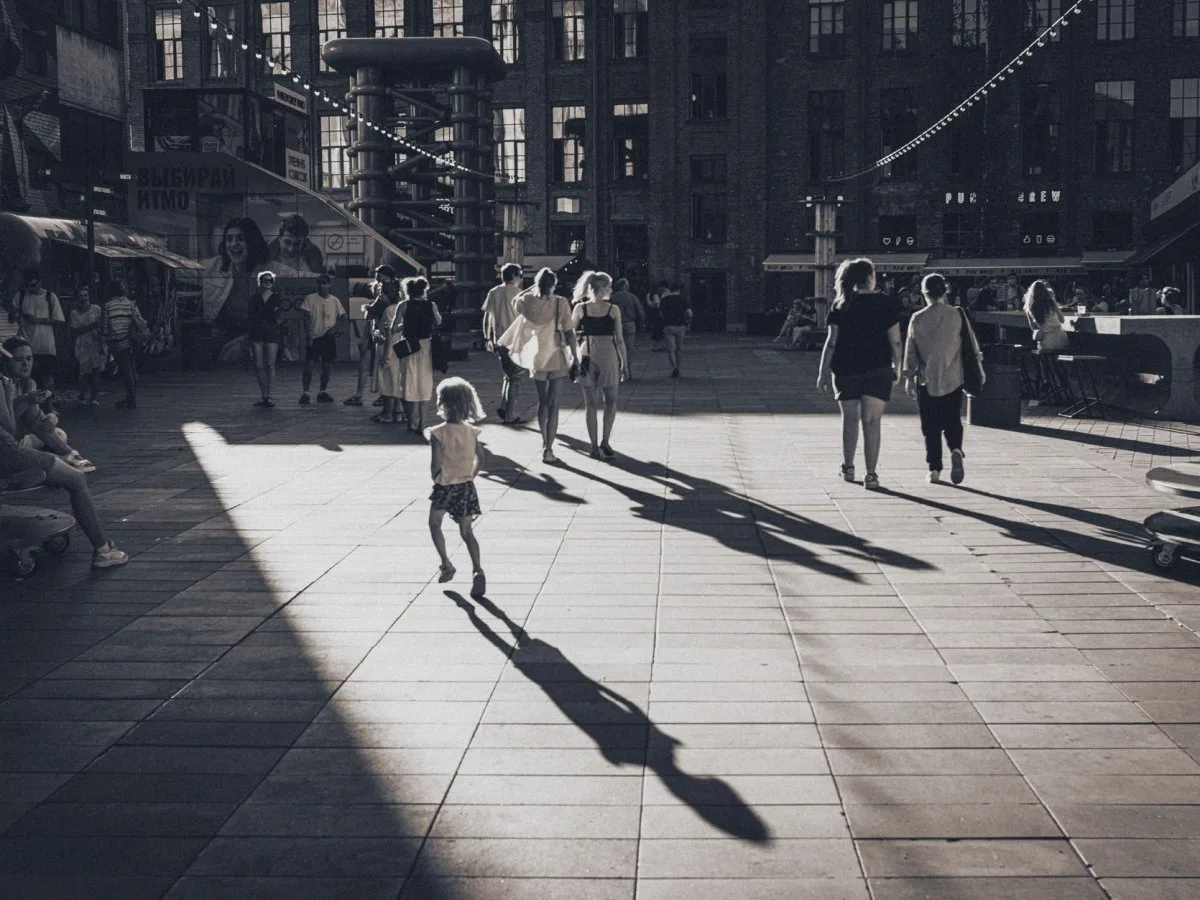
A public space does not function in isolation from its surroundings. The route people take to reach it, the uses of nearby streets and the needs of neighbourhood residents all affect how the space is experienced. An assessment focused on a site can therefore look beyond its physical boundaries and also consider the area people walk through to get there.
UN-Habitat’s Public Space Site-Specific Assessment, published in 2020, sets out an assessment of a selected open public space and a five-minute walking radius, which the document equates to 400 metres. This is not a universal measure of how far everyone should walk; it is the working framework the tool uses to gather information about a site and its surroundings.
Look at the space and its walkable radius
The selected site and its nearby connections form part of the same design question: what information is needed to understand how people experience the space and what changes might better respond to neighbourhood needs? The assessment aims to gather relevant data within the selected area and turn it into input for planning and design.
This approach links the scale of the place—the specific open space—with the everyday scale of access. As an interpretation, it invites us to observe not only what happens inside a plaza or other public space, but also how it connects with the surrounding fabric and the people who use it. The guide presents the five-minute radius as a working boundary, not as proof that everyone’s routes or experiences are the same.
From dialogue to design decisions
Participation is not reduced to gathering opinions at the outset and then presenting a finished design. The tool proposes a series of activities to facilitate exchange among the community, specialists and local authorities. Its purpose is to bridge community needs and technical design—a transition that can lose information if the different parties do not have opportunities to talk throughout the process.
Within this framework, the assessment brings together qualitative and quantitative information with and through the community. The results are used to examine public-space indicators and inform designs developed by specialists. The guide also connects this process with municipal decisions about where and how to allocate resources for improving public spaces.
Participation therefore serves a practical purpose: it helps bring neighbourhood priorities into the design discussion. At the same time, the process calls for community members, technical specialists and local authorities to take part in the planned activities. The guide does not present collaboration as an automatic guarantee of consensus; rather, it frames it as a structure for exchange and informed decision-making.
What a specific case can show
An experience described by UN-Habitat in 2021 shows how this type of assessment was initiated in two Palestinian refugee camps in Jordan: Souf and Al-Shahid (Husn). At introductory workshops organised with the Department of Palestinian Affairs, participants from services committees, local offices and engineering teams discussed conditions during the COVID-19 pandemic, improvement and maintenance needs, public toilets and awareness campaigns.
The team also led an exploratory walk through the public spaces with participants, allowing them to experience the surroundings together. The project, focused on improving access to water and sanitation in public spaces, framed the assessments as a way to understand the quality of these places and inform future projects. The case illustrates how shared observation can be part of the process; on its own, it does not show that the same priorities or solutions apply to other neighbourhoods.
An assessment as a starting point, not a final result
The value of a site-specific assessment lies in organising questions, voices and data to inform design. Considering the space and its walkable radius helps situate it within the everyday life of the neighbourhood; combining qualitative and quantitative information brings together different kinds of evidence; and maintaining exchange among the community, specialists and authorities can make the transition from needs to decisions more visible.
An assessment does not replace design or, by itself, ensure that an intervention will achieve particular results. It is a basis for better understanding a space and supporting subsequent decisions. The guide situates this work within the goal of promoting safe, inclusive, accessible and green public spaces, with particular attention to women, children, older people and people with disabilities.
At a glance
Scope
Editorial reading; this is not a site visit or a technical assessment.
Sources and references
Public Space Site-Specific Assessment: Guidelines to Achieve Quality Public Spaces at Neighbourhood Level | UN-Habitat ↗20/10/2026 UN-Habitat, Public Space Site-Specific Assessment: Guidelines to Achieve Quality Public Spaces at Neighbourhood Level, 2020.
Public Space | UN-Habitat ↗23/10/2026 UN-Habitat, Public Space.
UN-Habitat organizes discussions on improving two Palestinian refugee camps in Jordan | UN-Habitat ↗28/10/2026 UN-Habitat, UN-Habitat organizes discussions on improving two Palestinian refugee camps in Jordan, 2021.