





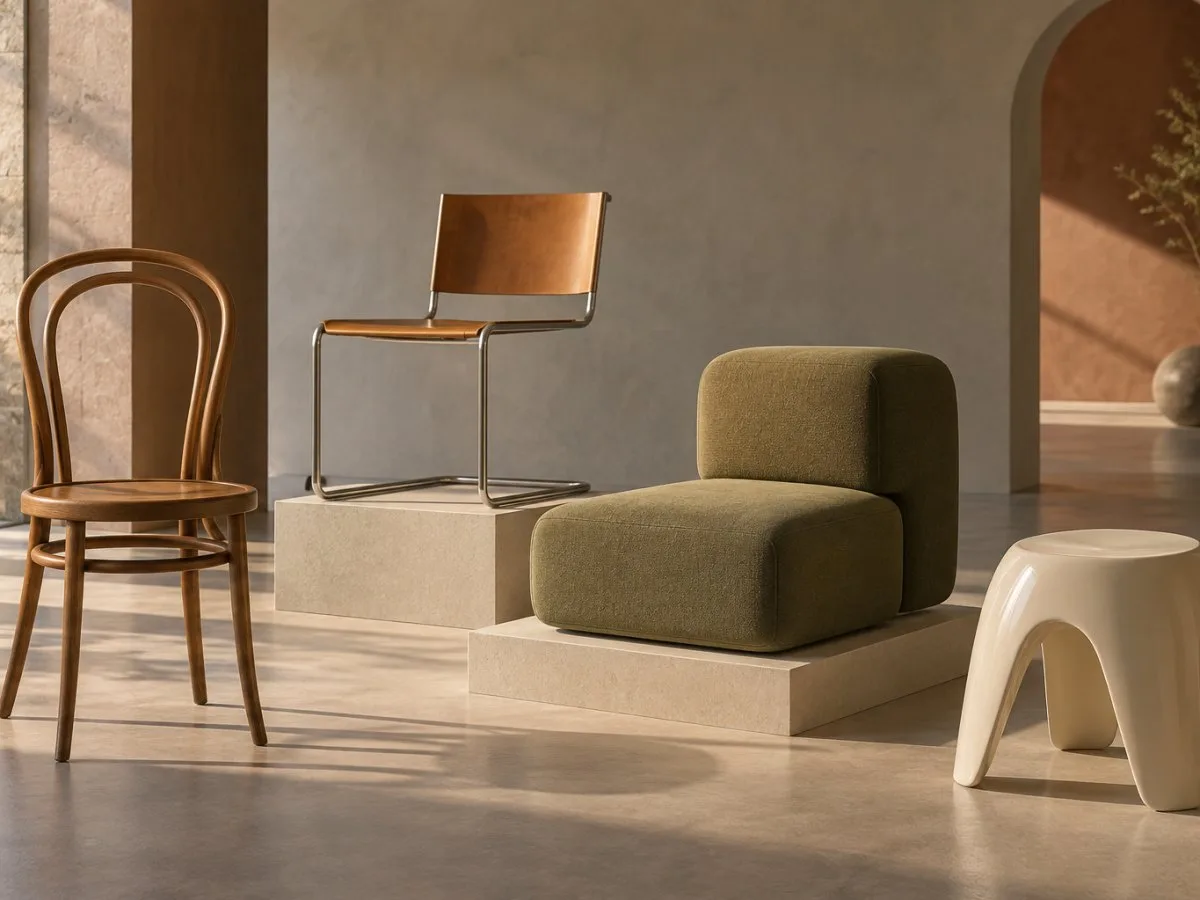
Reading furniture through time
A chair, a table, or a modular system can be understood both as an object for use and as a clue to its era. The Vitra Design Museum’s furniture collection organizes this history around major periods, movements, and figures in industrial design. Its core holdings comprise approximately 7,000 objects.
This is not a neutral succession of styles. Grouping pieces by period and tendency also invites us to consider how ideas about form and materials change, as do relationships between furniture and everyday life. This is one way to interpret the collection, not a claim about the specific function of every object.
From bentwood furniture to modernism
Among the nineteenth-century beginnings of modern design are bentwood furniture, the Vienna Secession, American patent furniture, and the Deutscher Werkbund. These examples show that the history of industrial furniture design is not limited to a single national tradition or one formal innovation.
Classical modernism comes next, with references to the Bauhaus and De Stijl, among other movements. Rather than treating these names as a definitive list, they can serve as points of orientation, helping situate objects and compare different design responses within the same period.
The postwar period and experimentation
The collection includes postwar design from Scandinavia and Italy, alongside work by American designers such as Charles and Ray Eames, George Nelson, and Alexander Girard. It also encompasses trends from the 1960s and 1970s: Radical Design, experimental plastic objects, modular furniture, and new concepts for offices.
The coexistence of these strands makes comparative interpretation possible. A modular piece can draw attention to organization and flexibility; an experimental object, to the exploration of materials and forms. These are questions visitors can consider when looking at the pieces, not features that can be attributed across the board to every object in those categories.
Postmodernism and contemporary practices
The collection’s scope extends to postmodern tendencies such as Memphis and Droog Design, and to contemporary practices associated with Critical Design, New Crafts, computer-aided design, DIY, and sustainable design.
The breadth of these categories makes clear that furniture design is concerned with more than an object’s appearance. It also raises questions about how an object is made, what ideas it challenges, and what relationship it proposes between design and society. The collection identifies these fields, but the available information does not detail how they apply to each piece. It is therefore useful to distinguish general themes from the particular characteristics of an individual piece of furniture.
One collection, several ways to tell its story
The Vitra Design Museum presents its collection as a foundation for exhibitions, publications, and research. Its Atlas of Furniture Design offers a different scale of interpretation: it documents 1,740 objects by more than 540 designers and includes essays on sociocultural contexts and design history, as well as texts on objects and a range of visual materials.
The relationship between an object and its context is especially useful when thinking about everyday spaces. Rather than asking only whether a piece belongs to a recognizable style, we can consider what formal decisions it displays, what materials it is associated with, and what ideas about use or collective life it suggests. This is a way of looking, not a technical assessment or an account of a visit to the collection.
Questions to ask when looking at a piece of furniture
- What period or tendency might help situate the piece, and what details suggest that?
- What role do form and material seem to play in its design?
- Is the piece presented as a standalone object, as part of a system, or in relation to an interior space?
- Which aspects of its history are documented, and which would be interpretations?
These questions do not replace information about a specific object. They offer a way to approach furniture with attention both to its presence in a space and to the history of design that can be read in it.
At a glance
Scope
Editorial reading; this is neither a visit nor a technical assessment.
Sources and references
Furniture ↗23/10/2026
Atlas of Furniture Design ↗23/10/2026
Collection ↗27/10/2026