





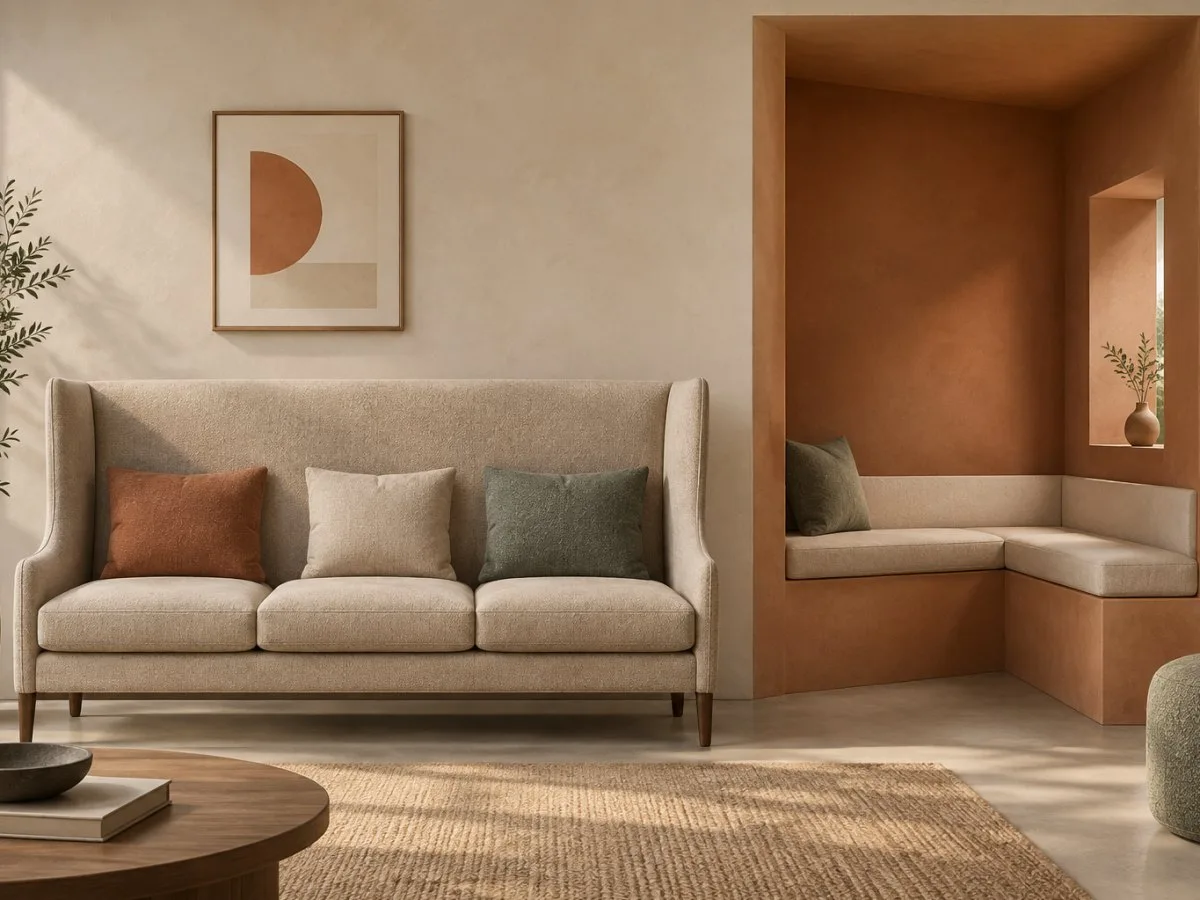
A sofa born in an alcove
At the Eames House, the living room retains an L-shaped alcove beneath the second-floor bedroom. The living room is 17 feet high, while the alcove’s ceiling drops to 8 feet, creating a more intimate space that is too narrow for a conventional sofa. For this recess, Charles and Ray Eames designed a built-in sofa that made more efficient use of space than a freestanding sofa.
The alcove bench was more than a simple seat: its profile followed a sequence of supports. An angled vertical cushion supported the upper back; a second, parallel vertical cushion provided lumbar support; and a horizontal cushion formed the seat. This arrangement of three cushions became the starting point for a broader idea: how to make a comfortable seat take up less space without sacrificing structure.
As an editorial interpretation, the alcove functions as a domestic design laboratory. It is not an exotic setting but a familiar constraint: low ceilings, corners, hallways, small rooms, and offices where furniture must coexist with circulation, tables, and conversation.
From built-in installation to consumer product
The alcove experiment did not remain confined to the house. In 1952, Charles and Ray Eames designed the offices of Philip Dunne at the Twentieth Century Fox studios in Los Angeles. In Dunne’s office, they installed a built-in sofa of the same three-cushion type as the one in their own home. The installation left ample room for both a meeting area and a separate seating area.
After these two installations, the first freestanding sofa for consumers appeared in 1954: the Eames Sofa Compact. Its profile follows the contours of the Alcove Sofa—the sofa designed for the alcove. The shift from built-in furniture to a mass-produced object was more than a change in format: it turned a spatial solution into a product that could be placed in different settings.
A high-backed, slender profile for small spaces
The Sofa Compact is characterized by clean lines, a high back, and a slender form. It aims to provide the comfort of a large, cushioned sofa with a more restrained presence, so it can fit in rooms of different sizes. Its intention is to be comfortable and slender, but also strong and durable, without taking up the space of a bulky sofa.
The model is associated with Herman Miller and offered in a range of high-quality upholstery fabrics. It is intended for homes and offices, where its silhouette can work as either a primary seat or a supporting element in corners, hallways, or waiting areas.
Folding as part of the design
One of the Sofa Compact’s defining historical features is its relationship to transportation. When first introduced, it was shipped as a flat-packed product, a format that reduced the volume it occupied. Historical examples show how the back folded down. Today, the design no longer folds and is sold as a fully upright sofa.
That history is more than a minor detail. Folding was not just a packaging feature; it was part of the product’s logic. In rail transport, volume could be more costly than weight. Reducing the space the sofa took up in transit helped make its distribution viable. The logistical lesson is built into the design history: the furniture had to reach more places without compromising its final form.
The Sofa Compact is also related to a 1951 wire-sofa prototype. Building on that line of development, the design was adapted to use fewer parts, eliminate some hand labor, and reduce production costs. In other words, compactness was not only an aesthetic concern; it also reflected an intention to make the sofa simpler and less expensive to manufacture.
Three cushions, a grammar of seating
The Sofa Compact’s profile inherits the grammar of the alcove sofa. Upper-back support, lumbar support, and a horizontal seat are translated into a freestanding object that maintains a clear relationship to the body. This is not simply a sofa made smaller by proportion; it is a seat that reorganizes its supports so that a smaller footprint does not mean a loss of structure.
This continuity helps explain why the model can be read as a bridge between two worlds: site-specific installations, where furniture is adapted to a recess, and consumer objects, which must work in different rooms. The Sofa Compact takes the lesson of the alcove and turns it into a portable format.
From home to office
The history of the alcove sofa shows that the same type of built-in sofa was used both in the Eameses’ home and in Philip Dunne’s office. At home, the alcove was a place for conversation and reading; a magazine rack was added during the first five years because Charles and Ray enjoyed sitting and reading there. In the office, the built-in sofa made it possible to organize a meeting area and a seating area without overcrowding the space.
The Sofa Compact extends this dual purpose. Its silhouette can work in a small living room, a corner of a home, a waiting room, or an office where seating is needed without competing with the table. The editorial interpretation is that the model does not belong to just one type of space, but to a particular condition: limited space, where furniture must be precise.
Documented facts and editorial interpretations
| Aspect | Documented fact | Editorial interpretation |
|---|---|---|
| Domestic origin | The Eames House living-room alcove had an 8-foot ceiling, compared with the living room’s 17-foot height, and could not accommodate a standard sofa. | The alcove served as a design laboratory for compact seating. |
| Built-in sofa | Charles and Ray Eames designed a three-cushion built-in sofa for the alcove. | That sequence of supports became the basis for the Sofa Compact’s profile. |
| Office | In 1952, they furnished Philip Dunne’s office with a similar built-in sofa. | The model showed that the solution could work beyond the home. |
| Mass-produced product | In 1954, the Eames Sofa Compact was introduced as the first freestanding sofa for consumers. | Turning a specific installation into a mass-produced object made the format reusable. |
| Transportation | When introduced, the sofa shipped flat-packed; today it is sold upright. | Its historical foldability reveals a logic of distribution and volume reduction. |
| Production | The design was adapted to use fewer parts, reduce hand labor, and lower production costs. | Compactness is also a manufacturing decision, not just a matter of form. |
A reading of everyday space
The Eames Sofa Compact can be understood as an answer to a practical question: how do you seat someone in a space that is not spacious? The answer is not a tiny sofa, but one that organizes comfort within a taller, narrower profile. The high back, lumbar support, and horizontal seat form a unit that can coexist with low ceilings, corners, and circulation routes.
It can also be read as an object that anticipates the importance of logistics in furniture design. Its historical flat-packed version shows that a piece of furniture’s final form is not the only thing that matters: how it arrives, how much space it takes up in transit, and how many parts it needs to be made all matter too. In that sense, the Sofa Compact is not just a compact sofa; it is an exercise in spatial precision.
At a glance
Scope
Editorial reading; it does not constitute a visit or technical assessment.
Sources and references
Sofa Compact | Eames Foundation ↗24/10/2026
S-73 (Sofa Compact) | Eames Foundation ↗24/10/2026
Alcove Sofa | Eames Foundation ↗24/10/2026