





Charles and Ray Eames approached design as a practice that could extend far beyond a single object. Their work encompassed furniture, architecture, films, exhibitions, photography, textiles, and toys. Taken together, this range makes it possible to read their careers not as the application of one fixed style, but as a way of investigating problems and turning ideas into tangible experiences.
Two paths that converged at Cranbrook
Charles Eames grew up in St. Louis and studied architecture for two years at Washington University. After leaving his studies, he opened an architecture practice with Robert Walsh, designing churches and homes in Missouri and Arkansas. Later, an invitation from architect Eliel Saarinen brought him to Cranbrook Academy of Art, where he became its first director of industrial design and met other designers, including Eero Saarinen.
Ray Eames, born in Sacramento, was interested in fashion, theater, and painting. She studied with artist Hans Hofmann in New York and helped found the American Abstract Artists group. After six years exploring structure and color through painting, she came to Cranbrook to expand her artistic practice. There she met Charles.
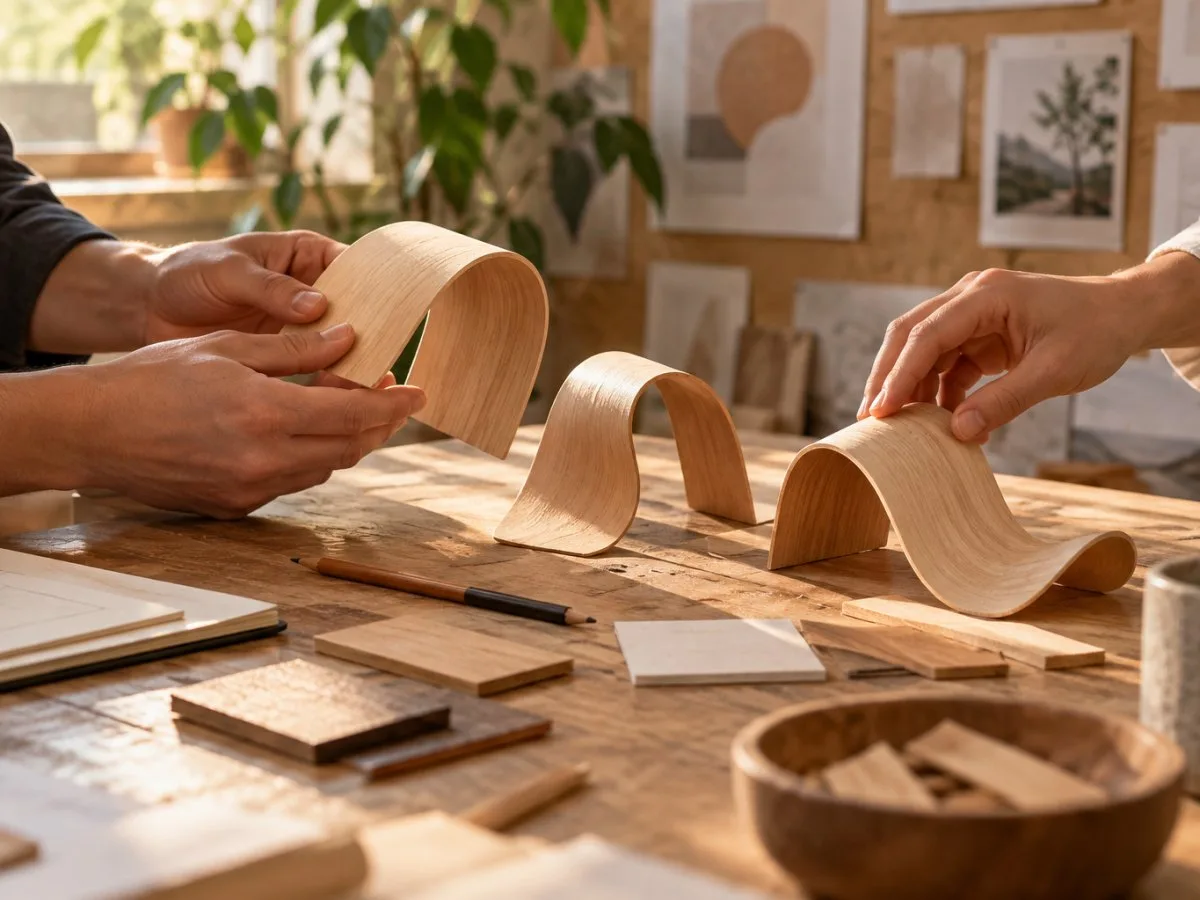
Their collaboration began when Ray helped Charles and Eero Saarinen with the proposal that won the Museum of Modern Art’s 1940 Organic Design in Home Furnishings competition. Charles and Ray married in 1941 and moved to Los Angeles. In their apartment, they began experimenting with molded plywood.
From material to design problem
During World War II, they adapted their techniques to produce leg splints and aircraft parts for the U.S. Navy. That work preceded the creation of Eames Office, a multidisciplinary space where architects, designers, and filmmakers collaborated. The office was also known as “901,” after its address on Washington Boulevard in Venice, California.
In their practice, recognizing a need was the starting point. The problem and its constraints guided decisions: what a project needed to solve and for whom. Paying attention to how people actually use things—instead of how they are supposed to use them—connected form with everyday function.
Experimentation helped develop those responses. Rather than relying mainly on sketches, the team turned to photographs, models, and full-scale mock-ups. Revisiting and modifying an idea made it possible to test its potential and refine the design. The 901 workspace supported this process with tools, work areas, a library, an organized slide archive, and photography darkrooms.
This account of the method suggests a broader interpretation: in the Eameses’ practice, creativity was not separate from production. Observing, building, evaluating, and revising were parts of the same work, whether the project was a piece of furniture, a film, an exhibition, or an institutional proposal.
An office spanning disciplines
Eames Office developed projects across different fields while keeping curiosity and problem-solving as guiding threads. Its legacy includes the Eames House, the Lounge Chair and its ottoman, fiberglass shell chairs, the film Powers of Ten, and the exhibition Mathematica. The diversity of these works contrasts with the idea that a fixed visual language should be the goal of design: a solution should respond to the problem, not impose a formula.
Experimentation also coexisted with respect for accumulated knowledge. Innovation was not necessarily an end in itself; it could be more useful to build on what had been learned and take it one step further. Charles’s response about the development of the Lounge Chair—a “30-year flash”—expresses this relationship between long experience and an idea that seems to arrive suddenly.
Continuity and legacy
Charles died on August 21, 1978. Ray continued the work of Eames Office in the years immediately afterward and later closed the active office to focus on preserving its legacy. She donated 1.5 million two-dimensional objects, including 750,000 prints and photographs, to the Library of Congress. She also prepared an encyclopedic volume about the office’s projects, lectured, and welcomed visitors and student groups to the Eames House. Ray died in 1988, on the tenth anniversary of Charles’s death.
Today, the Charles & Ray Eames Foundation preserves the Eames House and sustains educational programs, exhibitions, and collaborations. That continuity helps make sense of their legacy as more than a collection of recognizable objects: the way of working that made them possible matters too.
An everyday way of looking at design
The work of Charles and Ray Eames invites us to consider what need an object is intended to meet, how materials influence its development, and what testing an idea can reveal that leaving it on paper cannot. This reading does not turn every project into a universal recipe. It does offer a concrete way to connect curiosity, collaboration, and use: start with the problem, explore alternatives, and let the solution take shape through the work.
At a glance
Scope
Editorial reading; this is not a visit or a technical assessment.
Sources and references
Charles & Ray Eames Biography | Eames Foundation ↗25/10/2026