





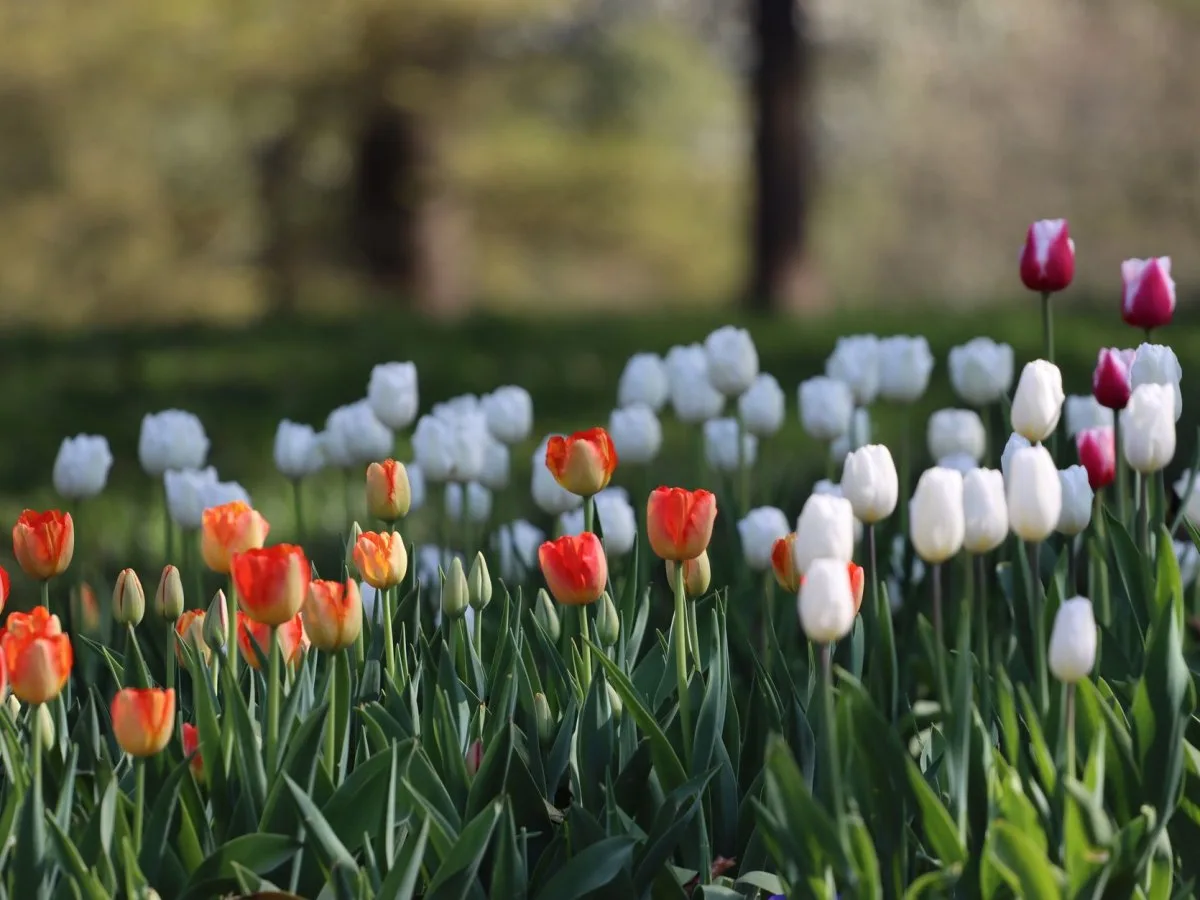
Bulbs are often imagined as a brief display: they appear, add colour to a corner and then disappear. In the garden, however, their appeal also lies in what happens before and after that moment. Beneath the soil they store reserves while dormant; above ground, their leaves and flowers create a temporary presence that can be arranged across the year.
One word, several ways of growing
In gardening, “bulb” is often used as a general term for different underground organs that store food. True bulbs—such as those of tulips, daffodils and lilies—are not the same as corms, tubers or rhizomes, although all serve a storage function while the plant is dormant.
The distinction is not only botanical; it also affects how plants appear in a space. Rhizomes, such as those of some irises, grow horizontally and produce roots, leaves and flowers along the swollen stem. Tubers may be swollen roots, as in dahlias, or swollen stem bases, as in cyclamens. That is why each plant’s label matters more than any single rule for everything sold as a “bulb.”
Composing with the calendar
Flowering can be spread across the seasons. Many spring-flowering bulbs are planted in autumn; summer-flowering ones, depending on the type, in autumn or early spring; and some autumn-flowering bulbs toward the end of summer. General growing guidance notes that different types flower in different months of the year, although spring stands out for its abundance.
This succession makes it possible to design the garden as a changing scene rather than a fixed composition. The first crocuses and snowdrops can give way to daffodils and tulips; later, lilies or gladioli bring summer flowers, while nerines can extend interest into autumn. These are examples of possibilities, not a guaranteed sequence: timing depends on the plant type and when it is established.
Grouping several plants of the same species or variety can create a clearer visual effect than scattering them individually. In borders, consider both flowering time and the height and space the plants will occupy after the flowers have faded. Some species can also naturalise in lawns or meadows; in pots, bulbs offer a way to concentrate colour on terraces, patios or at entrances.
The site shapes the composition
Many bulbs prefer a sunny position and well-drained soil, but this is not universal. Some species are adapted to shade or damp soil, so the available site should guide the choice. Rather than treating “bulbs” as a single growing category, it is more useful to consider specific combinations of species, light, moisture and soil type.
Pots broaden the possibilities when the ground does not offer suitable conditions or when you want to place flowers near an entrance or window. They also make it possible to move some plants as the seasons change. In return, potting mix can dry out more readily: container-grown plants need attention to watering during growth and should not be left in a waterlogged mix.
The flower finishes before the cycle does
After flowering, the leaves still have a role. For true bulbs and corms, the foliage should remain until it yellows and dries, because during this period it helps replenish reserves for the following season. Cutting it too soon or tying it up can impair later flowering. Removing faded flowers prevents seed formation in some cases, but it does not mean the plant will flower again.
Care also varies by type. Most hardy bulbs can remain in the ground over winter; some tender plants are grown in pots so they can be sheltered, or are protected in the ground only where local conditions and drainage allow. A congested clump can be divided every few years. Taken together, these tasks show that designing with bulbs is not just about choosing colours: it also means making room for dormancy, foliage and renewal.
An indoor experience on a different scale
Growing bulbs indoors brings this relationship with time to a domestic scale. Some spring-flowering plants need a period of cold to flower before their natural season; they can be bought prepared or chilled before being moved to a warm place. Paperwhite daffodils and amaryllis have different requirements, so there is no single indoor schedule for every species.
A pot on a windowsill can make visible a process that takes place underground in the garden: dormancy, sprouting and the opening of a flower. For this experience, choosing the species and following the package instructions are part of the project, not an afterthought.
Bulbs therefore offer more than seasonal colour. Their design value lies in combining scales and timings: the small group that signals spring, the pot that concentrates a display, the leaves that remain after the flowers are over, and the species that return year after year. A successful composition does not try to keep everything in flower at once; it makes use of change and recognises that each plant has its own rhythm.
At a glance
Scope
Editorial reading; this does not constitute a site visit or a technical assessment.
Sources and references
How to grow bulbs / RHS Growing Guide ↗30/10/2026
Bulbs: Planting Tips | RHS Advice ↗30/10/2026
Grow indoor bulbs in class / RHS ↗30/10/2026