Expanded and reviewed with additional sources on
Wood is not a complete specification
Stating that an element is "made of wood" is insufficient to anticipate how it will behave, how it will appear over time, or what care it admits. To evaluate a surface, it is advisable to distinguish, at a minimum, the species or composition, the component and its construction, the surface finish, and the usage conditions. These are layers of related information, but none replaces the others.
Wood presents characteristics that vary with its composition and the conditions to which it is exposed. There are also composite products and different finishes, each with its own properties and needs. Therefore, a visual or commercial designation does not equate to a usage specification. A general reference can help understand phenomena such as the relationship between moisture and dimensional changes, but it does not by itself determine the composition of a specific product, its condition, or its suitability for an application. For that, the data of the specific component and product under consideration are required.
This guide is conceptual: it does not document an executed work, a material test, or a validated technical recommendation. Its purpose is to organize the comparison and make uncertainties visible, not to select a species, prescribe a finish, or certify the state of an element.
Four distinct questions for comparison
1. What material is it?
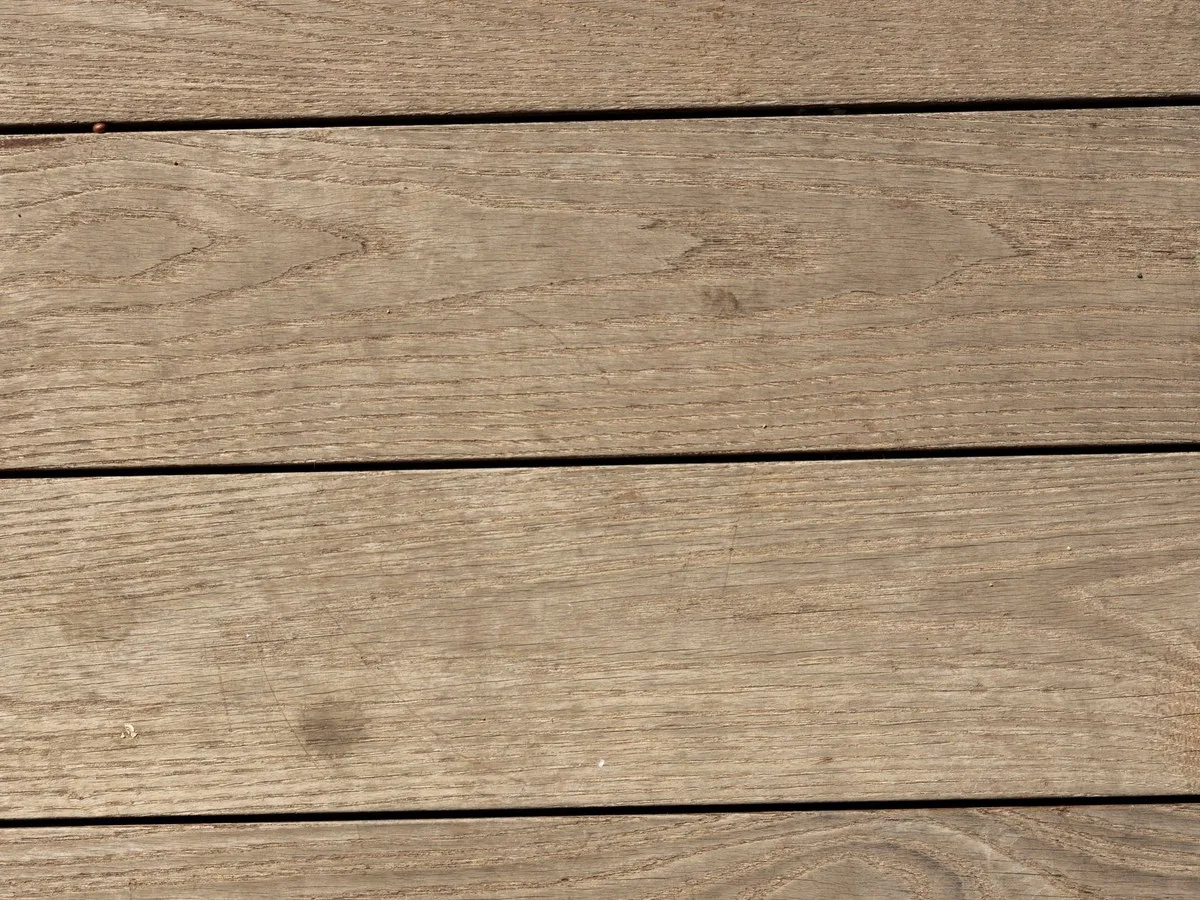
The species can provide relevant information, but it does not by itself describe a finished component. It may also be a composite product, and a similar appearance does not prove that two samples have the same composition. Useful information is that which identifies the specific product or material and clarifies what is effectively present.
Therefore, a sample must be read as a sample of an appearance and a declared identification, not as automatic proof that another component, batch, or existing element is identical. If the composition is unknown, it must be recorded as pending, rather than inferred from color or grain.
2. What component is being evaluated?
Wood and wood products can be presented in different components and constructions. To compare options, one must identify which component is being examined and gather available information about its composition and manufacturing. A generic name or an image is not enough to deduce dimensions, performance, or allowable loads for a specific application.
A photograph, a small sample, or a commercial sheet can help pose questions, but they do not replace the specific documentation of the component. If the comparison depends on a characteristic that does not appear in that documentation, it is advisable to leave it explicitly unresolved.
3. What finish does it have and in what state is it?
The finish changes the visible surface and conditions the possible care. Before cleaning a surface, it is important to identify the coating, assess its stability, and know previous interventions. Therefore, "wood" does not identify the finish, nor does it allow assuming that a surface can be cleaned or repaired in a specific way.
Recommendations for furniture finishes are not universal recipes for floors, architectural elements, or other objects. If the finish is unknown, deteriorated, has peeling paint, or the surface seems sensitive, the diagnosis is not resolved by testing a product by intuition. These cases may require the evaluation of a conservator.
4. Under what conditions is it used and maintained?
Habitual use, exposure to light, humidity, cleaning, and the circulation of the space are part of the context being compared. They do not by themselves determine the appropriate treatment, but they help describe what conditions the evaluator of the solution must consider.
The relationship between moisture and dimensional changes provides context for not treating wood as an unchanging material. However, without specific information about the product and the location, it does not establish what change will occur in a particular case. It is also important to prevent abrasion and unnecessary exposure to light and humidity. In a real decision, it is more useful to note the observed conditions and doubts than to turn those general principles into a performance promise.
Sample, manual, and record: three different evidences
Not all resources answer the same question. A sample serves to observe the appearance of an identified material, but it only represents the available sample. A manual provides general context about materials and phenomena; it does not confirm what product is in a specific location. A record gathers particular information about the element—for example, its declared product, known finish, documented interventions, and indicated care—although its reliability depends on whether it truly corresponds to that component.
| Resource | What it can help establish | What it does not prove by itself | What is advisable to note |
|---|---|---|---|
| Identified sample | Appearance of the sample and accompanying data | That another component, batch, or surface has identical composition, finish, or state | Declared identification, available provenance, and doubts of correspondence |
| General manual | Context on wood characteristics, humidity, composite products, or finishes | The composition, condition, or suitability of a specific element | Topic consulted and specific question that remains pending |
| Product sheet | Declared information for that product | That the sheet corresponds to an existing component if its identity has not been verified | Name or identification of the product and correspondence with the evaluated element |
| Maintenance or intervention record | What was documented about previous care or interventions | That there have been no unrecorded actions or that the current finish is identified | Available date, described intervention, provenance of the record, and gaps |
| State observation | Visible signs and conditions observed at the moment | Diagnosis of the finish, internal composition, or structural safety | What was observed, on which element, and what requires additional evaluation |
The utility of each resource depends on the question. To identify an unknown finish, a photo or an appearance sample may be insufficient. To understand a general phenomenon, a manual may be pertinent even if it does not identify the component. To know what product was installed, the record is only convincing if it can be linked to the specific element.
Care depends on the identified finish
The most important practical recommendation is not to mix instructions intended for different surfaces. The maintenance of wood floors varies depending on whether they are varnished, oiled, or treated with soap; removing dirt and avoiding excess moisture are relevant considerations, but the products and processes depend on the surface treatment. An instruction for an oiled floor should not be transferred without further consideration to an unknown finish, nor does that distinction justify recommending a generic domestic sanding.
Guidelines for furniture finishes prioritize identifying the coating, its stability, and previous interventions before cleaning. If the finish is in poor condition or not recognized, prudence consists of stopping at identification and seeking an appropriate evaluation, not improvising with solvents or cleaners. These differences support a rule of comparison, not a domestic protocol valid for all wood.
It is also advisable to distinguish ordinary care from conservation and state evaluation. Removing dirt according to instructions specific to an identified product does not equate to repairing a deteriorated coating, and neither of those tasks certifies the structural integrity of a component. The scope of the decision must be clear from the beginning.
Comparison sheet before deciding
Complete an independent sheet for each option or element. Write "unknown" when evidence is missing: do not substitute that data with an assumption based on appearance.
| Sheet field | Question to complete | If the answer is missing |
|---|---|---|
| Evaluated element | What specific component or surface is being compared? | Delimit the element; do not attribute sample data to the entire installation. |
| Material or composition | What identification exists and in which document? | Note "not identified" and request information from the corresponding product. |
| Type of component or product | Is it solid wood, a composite product, or another declared construction? | Do not deduce the construction by appearance; leave the classification pending. |
| Finish | Is it known what coating or surface treatment it has? | Do not apply instructions specific to another finish. |
| Visible state | What signs are observed, without turning them into a diagnosis? | Describe what was observed and point out what requires evaluation. |
| Use and conditions | What use, light, humidity, cleaning, or traffic are relevant in that space? | Gather context information before comparing care or expectations. |
| History | Is there a record of maintenance or previous interventions? | Mark the gap; an unknown history does not equate to a non-existent history. |
| Applicable instruction | Does the consulted guide correspond to that product and finish? | Do not extrapolate procedures; seek specific documentation or pertinent advice. |
| Limit of the decision | What can be concluded and what remains outside this review? | Avoid presenting a visual comparison as technical approval or diagnosis. |
How to use and interpret the sheet
First, complete a sheet for each option without mixing the data of a sample with those of an existing surface. Then, classify each answer as documented, observed, or unknown. "Documented" means there is identifiable information linked to the element; "observed" describes what is seen without attributing a cause; "unknown" indicates there is not enough basis to affirm it.
Next, compare only the fields that can answer the same question. A sample can help compare appearance; a product guide can describe the maintenance of a specific finish; a general manual can provide context about wood. Do not turn that information into a superiority classification if comparable criteria are not specified.
The decision can advance when it is understood which data are applicable and which are not. If the choice depends on the composition, finish, state, or a usage condition that is not identified, the sheet must show that dependence as an uncertainty. This allows formulating the next question—which document is missing, which element must be identified, or what evaluation is needed—without simulating a technical answer.
Scope of the sheet
This sheet is a conceptual resource and does not accredit that a space has been inspected or a product tested. The general context on wood, humidity, and composite products, the conservation considerations for furniture finishes, and the maintenance differences between varnished, oiled, and soap-treated floors help pose distinct questions. None of those guidelines, by itself, identifies a specific component or validates an intervention for an undescribed case.
At a glance
Editorial series
Material to material
Documented gallery

Sources and references
US Forest Service, Forest Products Laboratory · Wood Handbook, revisión 2021 ↗Consulta documental de 19 de octubre de 2026 · 19/10/2026
Canadian Conservation Institute · Care of Furniture Finishes, Notes 7/2 ↗Consulta documental de 19 de octubre de 2026 · 19/10/2026
Junckers · Cleaning and Maintenance of Hardwood Floors ↗Consulta documental de 19 de octubre de 2026 · 19/10/2026