





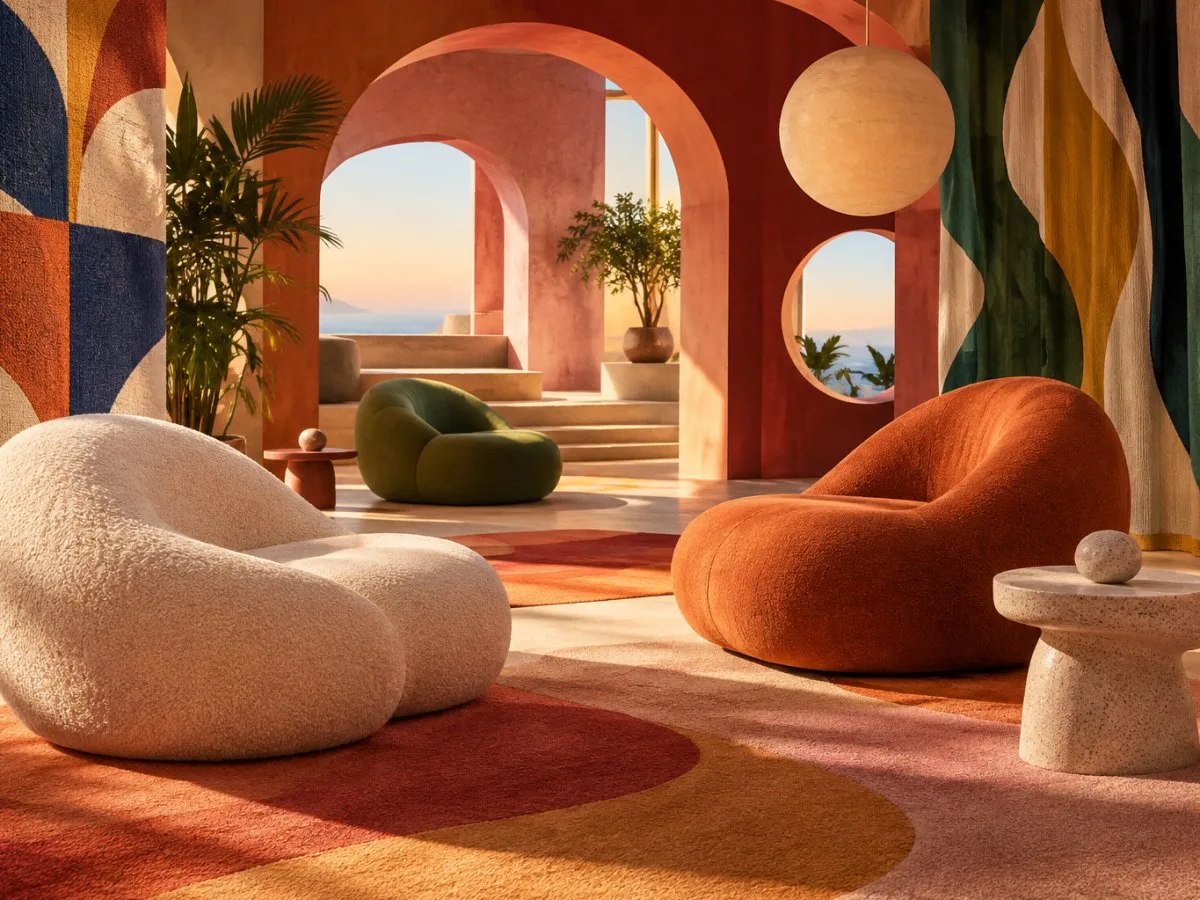
Verner Panton (1926–1998) understood the interior as more than a backdrop for furniture. In his projects, color, light, textiles, and furniture forms could work together to define the atmosphere of a room. This idea runs through both his best-known objects and his proposals for complete spaces.
From Danish design to a new idea of the interior
Trained as an architect at the Royal Danish Academy of Fine Arts in Copenhagen, Panton began his professional career in Arne Jacobsen’s studio. He emerged from a tradition known for furniture design, but from the late 1950s onward he developed his own spatial concepts, taking a freer approach to color and domestic organization.
Rather than simply placing pieces in a room, he explored how furniture could alter the perception and use of space. Swings, suspended seats, and multi-level compositions gave his interiors an informal, playful quality. Light, patterns, and gradations of color helped establish the character of each environment.
Objects that suggest other ways of living
The Panton Chair brings together several of the designer’s interests in a single object. Its basic concept dates to the mid-1950s, although it did not go into serial production until 1967, in collaboration with Vitra. Its continuous form, without rear legs and made from a single piece of synthetic material, departed from the conventional chair structures of the time.
Other designs, such as the Cone Chair and the Flowerpot lamp, show the breadth of his work with furniture and lighting. They are not merely pieces with recognizable silhouettes: they also form part of a broader exploration of how shapes and colors can change the way an interior is read.
Visiona II: space as an immersive experience
In 1970, Panton created the Fantasy Landscape for the Visiona II exhibition, realized in collaboration with the chemical company Bayer. The project explored the possibilities of new synthetic materials and turned domestic space into an organic composition saturated with color. Instead of clearly separating each piece and area, it brought furniture, surfaces, and forms together in a continuous whole.
The Fantasy Landscape exemplifies Panton’s ambition to treat the interior as a complete experience. Its effect did not depend on a single piece of furniture, but on the relationship between forms, colors, and spaces for sitting or reclining. The proposal invites us to consider how an environment can encourage less rigid uses than those associated with a room organized around separate pieces of furniture.
From holistic projects to everyday life
During the 1960s and 1970s, Panton expanded his work from furniture and textiles to complete furniture systems and interiors for private and corporate spaces. His projects included the Visiona exhibitions of 1968 and 1970, the interior of the Der Spiegel publishing house in Hamburg in 1969, and the Varna restaurant in Aarhus in 1971. In these commissions, different elements could be integrated into environments with a distinctive character rather than treated as isolated decorative decisions.
To observe this approach to design in a home, it can be useful to notice the relationships between its elements: how color changes the perception of an area, how light accompanies a form, or how a piece invites someone to sit in a different way. These are prompts for interpretation, not technical instructions or an assessment of a space’s performance.
A body of work that kept evolving
Panton’s work in the 1980s and 1990s continued to develop his formal language, with color and play remaining persistent themes. His career cannot be reduced to one celebrated chair or a single interior: it encompasses furniture, lighting, textiles, systems, and architectural projects, including designs that mostly were never realized.
Taken as a whole, his work proposes viewing domestic space as an active composition. A piece of furniture can be a starting point, but the surrounding atmosphere, the light, the colors, and the ways people can occupy the space also matter. This perspective helps explain why Panton’s designs are best understood as part of an investigation into interiors, rather than as isolated objects.
At a glance
Scope
Editorial reading; this does not constitute a visit or a technical assessment.
Sources and references
Verner Panton: Form, Colour, Space ↗09/11/2026 Vitra Design Museum, “Verner Panton: Form, Colour, Space”.
»Verner Panton. Form, Colour, Space« Programm zur Ausstellung ↗09/11/2026 Vitra Design Museum, “»Verner Panton. Form, Colour, Space« Programm zur Ausstellung”.
Current Exhibitions ↗09/11/2026 Vitra Design Museum, “Current Exhibitions”.