





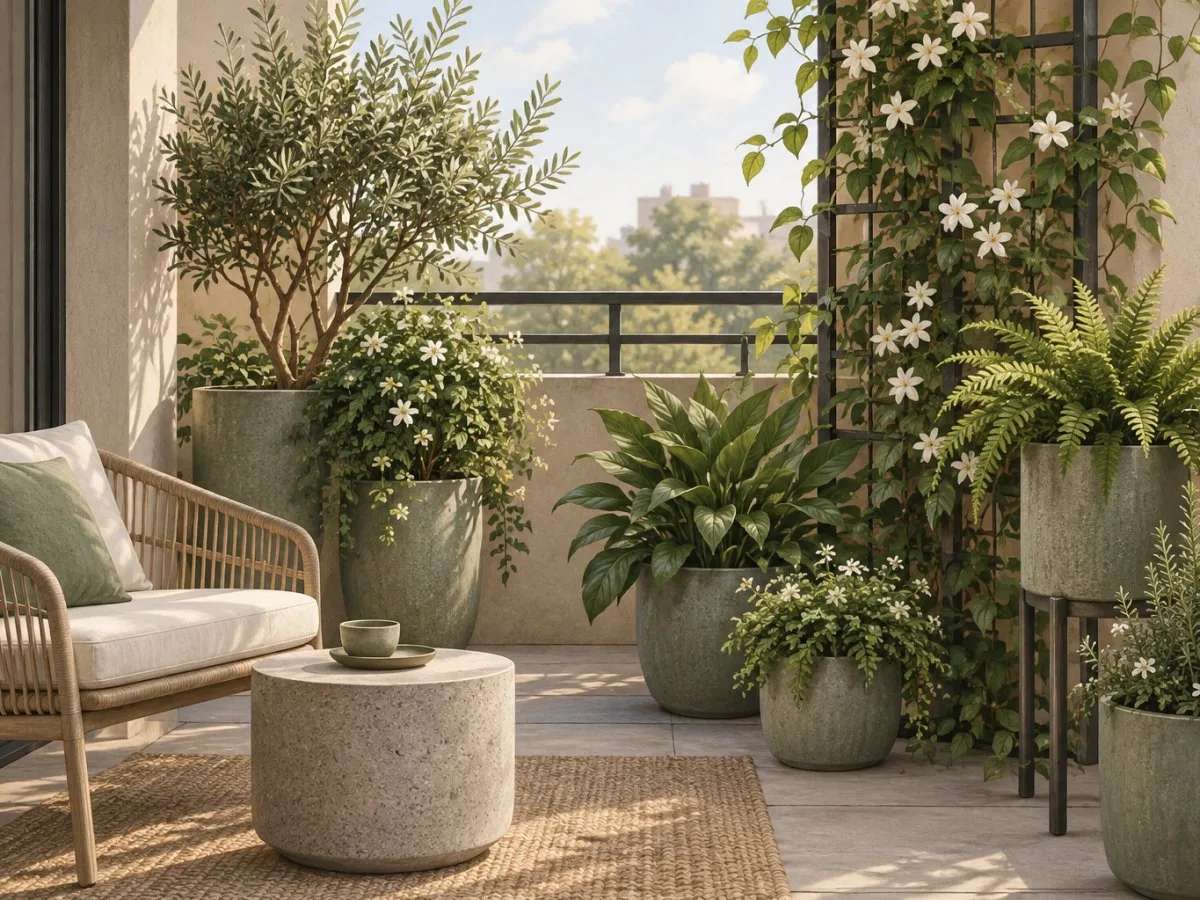
Designing compact green spaces—courtyards, balconies, rooftops or windowsills—presents a particular challenge: making the space feel larger and work well within strict physical limits. Unlike expansive gardens, where scale can absorb errors of proportion, in small spaces every element, from the choice of container to the height of a plant, contributes directly to how the whole composition is perceived.
This article examines design principles for these settings, distinguishing between the physical structure of the space, plant selection and visual composition. It focuses on how planning, verticality and stylistic coherence can help create cohesive, functional spaces.
Structure as the foundation of design
In compact spaces, the architectural structure and hard landscaping define the framework for the planting. Treat the design as a complete project, prioritizing the structure before planting rather than building the garden piecemeal.
Lines, shapes and repetition
Modern, minimalist design offers a useful framework for understanding structure in small spaces. Its principles include:
- Clean lines and uniformity: Straight lines in paths, borders and timber panels help create a tidy, uncluttered appearance.
- Repeated patterns: Repeating elements, such as timber panels on opposite walls or the shapes of containers, creates visual cohesion.
- Limited palettes: Restricting the selection of plants and colours—for example, green and white, or contrasting green and red—simplifies the composition and helps avoid visual clutter.
One example is an urban courtyard where brick walls at different heights form both the backs of seats and the edges of raised beds. The planting is limited to clipped box (Buxus) spheres and white-flowered Agapanthus. The contrast between geometric lines and circular forms defines the space as an “outdoor room.”
The role of containers
Containers are not just vessels for growing medium; they are design tools that let you adapt the space to the plant’s needs, and the plant to the space. In small spaces, containers can serve several purposes:
- Control of growing medium: They allow you to grow plants that need specific conditions—such as acidic soil for rhododendrons or camellias—regardless of the local soil.
- Flexible placement: They make it easier to rearrange plants according to light, season or maintenance needs.
- Aesthetic integration: Choose containers to complement interior decor or building materials, or to introduce a particular colour or texture.
When choosing a container, consider drainage and its capacity to hold growing medium. Slow-growing or smaller plants still need enough soil volume; this is especially important for trees or shrubs trained on supports.
Strategies for using vertical space
Where floor space is limited, verticality is a key way to expand planting capacity and create visual depth. Walls, railings, shelves and other supports can all bring growing space off the ground.
Surfaces for climbers and supports
Walls, fences and support structures provide places for climbers such as roses, wisteria and honeysuckle to grow. For these plants, use the largest container that fits the space: they need a substantial volume of soil for successful long-term growth. Providing adequate structure and growing medium is an important investment in vertical planting.
Shelves and levels
Wall-mounted or freestanding shelves can raise plants and create visual levels. This approach:
- Makes use of overlooked corners and angles.
- Displays plants and ornaments like a shop window.
- Makes it easier to rotate plants according to the season or visual interest.
Think of the space as a display, where arranging plants at different heights creates ongoing visual interest.
Hanging baskets and railing planters
On balconies and in areas with limited floor space, hanging baskets and railing planters make room for trailing or spreading plants. These positions are often exposed to wind and more extreme weather, so choose plants for toughness and their ability to cope with the conditions. Railing planters, in particular, can add greenery and privacy without taking up floor space.
Plant selection and palettes
Plant choices for small spaces should balance year-round visual interest with maintenance needs and the conditions of the microclimate. Consider these approaches:
Seasonal interest
A small space should offer something in every season. A planting scheme can combine:
- Evergreens: For structure and lasting colour.
- Spring bulbs: For a seasonal burst of colour.
- Summer perennials: To fill the space in the main growing season.
- Autumn colour or texture: To maintain visual interest as the season changes.
- Conifers or other evergreens: For structure and colour in winter.
A dwarf pine, for example, can serve as a focal point, providing year-round structure and green colour alongside spring bulbs and summer perennials.
Colour and texture palettes
A coherent palette of colour and texture helps avoid visual clutter. Two possible approaches are:
- Tonal palettes: Soft, related tones—such as the russet leaves of Heuchera, bronze grasses and blue Salvia flowers—create a calm, cohesive effect.
- Colour contrast: Opposing colours on the colour wheel, such as green and red, can create a strong, modern impact, especially when used with a limited number of elements.
Low-maintenance plants
For gardeners with little time for upkeep, perennial plants and ornamental grasses can form the basis of a planting scheme. They generally need less attention than annuals and provide structure and colour through the seasons. One example is a garden of perennials and grasses that takes on golden and bronze tones at the end of summer, retaining visual appeal even in winter.
Functional spaces and displays
Small spaces can be designed for specific purposes as well as appearance, such as displaying collections or growing food.
Collections and “theatres”
A dedicated display can showcase plant collections such as auriculas or bonsai. These spaces need an arrangement that allows each plant to be looked at closely, like a display case or theatre. Prioritize form, colour and texture when choosing plants, and arrange them to make rotation and maintenance easier.
Growing food in containers
Containers are suitable for growing herbs, vegetables and fruit because they make it easier to manage watering, feeding and crop rotation. Plants in containers can be monitored regularly, and annual crops can be replaced during the growing season. Fruit trees grown in containers need support structures and large containers.
Design and maintenance considerations
Designing a small space calls for careful planning that takes account of how structure, planting and maintenance interact. Key considerations include:
- Plan as a whole: Treat the project as a complete design, prioritizing structure and container placement before plant selection.
- Maintain stylistic coherence: Keep colour, texture and form consistent to avoid visual clutter.
- Use verticality: Make use of vertical surfaces to expand planting capacity and create depth.
- Choose suitable plants: Select plants that provide visual interest throughout the year and suit the microclimate.
- Plan for maintenance: Consider the time and resources available for garden care when choosing plants and structures.
Designing a small space is not simply a matter of fitting plants into a limited area. It is about creating a cohesive composition that makes the most of its function and visual interest. Planning, coherence and the thoughtful use of vertical space and containers are central to that approach.
At a glance
Scope
Editorial reading; it is not a site visit or a technical assessment.
Sources and references
Planting design for small garden spaces ↗06/11/2026 RHS. “Planting design for small garden spaces.” Royal Horticultural Society.
Six stylish small garden design ideas ↗06/11/2026 RHS. “Six stylish small garden design ideas.” Royal Horticultural Society.
Modern and minimal garden ideas ↗06/11/2026 RHS. “Modern and minimal garden ideas.” Royal Horticultural Society.