





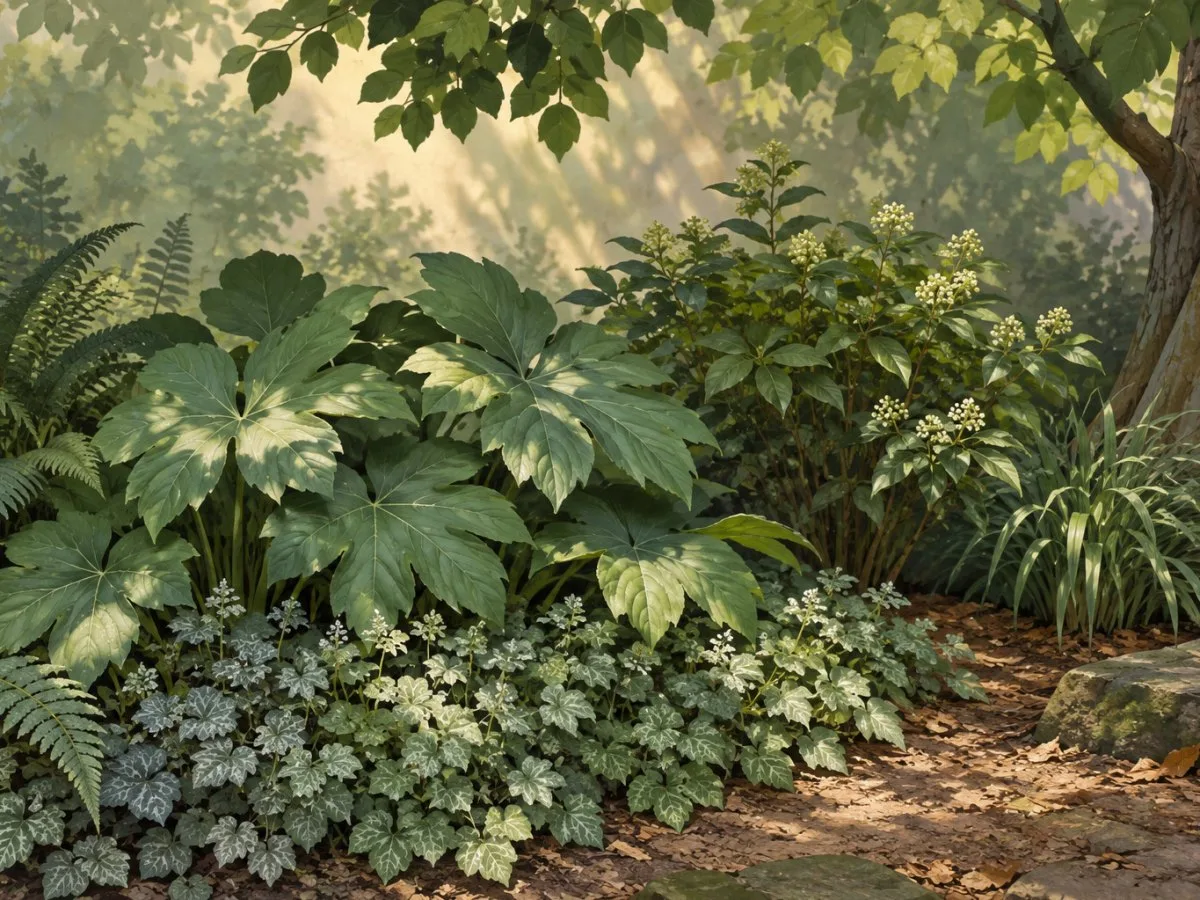
Shade in a garden is not simply the absence of sunshine. It is a set of conditions shaped by direct and diffuse light, soil moisture, competition from roots, and the form of the surrounding space. A bed beneath a building’s overhang may be dry for different reasons than one beneath a mature evergreen canopy, even when both receive little direct sun. Successful design begins by identifying those differences and matching plants to the actual microclimate.
Read the light before choosing plants
Green plants use sunlight to produce the sugars that supply energy and support growth. Less light can mean less growth and flowering; in a site that is too dark for a plant, it can eventually fail. But the label “shade” covers a range of conditions, and direct sunlight is not the only useful light: an open sky can provide diffuse light even where the sun does not reach the ground directly.
The amount of light also changes through the day. At midsummer, midday sun supplies considerably more light than morning or evening sun, so counting hours alone can miss an important difference between sites. A position receiving a short period of midday sun may offer more usable light than one receiving the same number of hours early or late in the day.
Plants also respond to the quality of light. Pigments detect changes in its composition, including changes in red and blue light. Some plants react to shade by lengthening their stems in an attempt to grow towards brighter conditions. This shade-avoidance response can produce weak, elongated growth, so many climbers are poorly suited to remain in a shady bed. Others tolerate shade by developing broader, thinner leaves with more chlorophyll, helping them capture the light available. These are useful distinctions, but neither response makes every shade-tolerant plant suitable for every shaded site: moisture and soil conditions still matter.
A practical shade classification
These categories describe typical midsummer conditions. They are a starting point for observation, not a substitute for noting how light falls on a particular bed over the day and year.
| Site condition | Typical definition | Design implications |
|---|---|---|
| Full sun | More than six hours of direct sun per day | Choose plants suited to sun. Shade-loving plants may need ample watering in summer if grown here. |
| Light shade | Open to the sky but screened from direct sunlight by an obstacle, such as a high wall or group of trees | Many plants that do not require full sun can grow here, often with less flowering. Mulch and autumn planting can help establishment. |
| Partial or semi-shade | Three to six hours of direct sun per day | Shade-loving plants can thrive; sun-loving plants may survive but often flower less. The timing of the sun, especially around midday, matters. |
| Dappled shade | Mainly reflected or diffuse light, often filtered through a relatively open tree canopy | Shade plants can do well, though watering may be needed. Adding well-rotted organic matter can improve soil structure and aid establishment. |
| Moderate shade | About two to three hours of direct sun per day | Foliage is often a more dependable design feature than flowers. Pots may help where the soil remains excessively dry or waterlogged. |
| Deep or heavy shade | Usually less than two hours of direct sun per day; often beneath dense tree cover or beside an overhanging building | Plant choice is limited, particularly when the soil is also dry and poor. Prioritise plants known to tolerate the specific conditions. |
The categories overlap in practice. In particular, “partial shade” can be used loosely, while “dappled shade” describes the pattern and source of light rather than a precise number of hours. Observe the site instead of treating a label as a guarantee of how a plant will perform.
Separate shade from dryness
A common design mistake is to assume that a shady bed must be damp. Tree shade can be dry: roots compete for water, and dense evergreen canopies can shelter the soil from rain. Buildings and fences can also cast a rain shadow, where precipitation does not reach the ground effectively. Areas close to walls may be especially dry beneath eaves or where shelter reduces exposure to wind.
Deep shade beneath conifers or evergreen trees can combine low light with dry, sheltered conditions. Fallen needles and other debris may also contribute to acidic soil. These factors explain why a plant that tolerates shade in a moist bed may struggle beneath a dense canopy. Conversely, plants that prefer moist conditions need not be ruled out from every shady position, provided the soil and water supply suit them.
For dry shade, select plants adapted to low moisture as well as low light. Waxy or slightly hairy leaf surfaces can help limit moisture loss, while low-growing plants can cover bare soil, reduce surface evaporation and suppress weeds. Those benefits do not remove the need for establishment care: plants adapted to dry shade may still need monitoring and watering during their first spring and summer.
Build the garden in layers
A shaded garden often offers fewer reliable flowers than a sunny one, especially in deeper shade. A more resilient design uses foliage, shape and seasonal changes as well as blooms. Layering shrubs above smaller plants and ground cover gives the space depth, while differences in leaf size, colour and texture help distinguish one planting from another.
Structural shrubs
Medium and larger shrubs can give a shaded bed its framework. The following examples offer different forms of interest; suitability still depends on the soil, degree of shade and moisture available.
- Aucuba japonica has glossy, often speckled foliage. Red berries can form in autumn if the flowers are pollinated by a male plant.
- Camellias, including Camellia sasanqua and C. japonica, can add winter or spring flowers. Some prefer acidic soil and moist conditions, so they are not an automatic choice for dry shade.
- Mahonia combines toothed foliage with yellow, often fragrant winter flowers. Different species and cultivars vary in size and flowering season.
- Viburnum tinus can flower from late winter into early spring. Viburnum × hilleri ‘Winton’ offers dark green foliage that can take on a bronze-red tint in winter, followed by scented, creamy-white flowers in early summer.
- Fatsia japonica has large, palmate leaves that provide a bold, tropical-looking shape in a shaded planting.
These shrubs illustrate why “shade-tolerant” is not a complete planting specification. A camellia that suits an acidic, moist position may not be a good match for a dry bed under tree roots; an evergreen shrub may provide dependable structure but does not by itself resolve a shortage of water or suitable soil.
Ground-covering plants
Low-growing plants can knit the lower layer together. Once established, they can help cover bare soil, reduce erosion and limit space for weeds.
- Vinca offers evergreen foliage and flowers over a long season. Vinca minor and V. major differ in scale; choose with the available space and desired spread in mind.
- Euonymus fortunei can provide persistent, sometimes variegated foliage in shaded areas.
- Mahonia aquifolium is a compact option with spiny leaflets and yellow flowers.
- Gaultheria procumbens suits acidic soil and has red berries that can persist through winter.
- Epimedium and Geranium macrorrhizum are useful candidates for dry shade, where their low growth can contribute ground cover as well as foliage and flowers.
- Cotoneaster procumbens can offer an evergreen ground-covering layer, with flowers and red fruits in some cultivars.
Spreading plants need enough room to form the cover intended. Their eventual spread and behaviour should be checked for the site rather than assumed from a general description.
Interest beyond flowers
Shade planting can be designed around a sequence of features rather than a single flowering peak. Evergreen leaves maintain structure; variegated or winter-coloured foliage can lift darker areas; scented winter flowers and persistent fruits add seasonal interest; and ground-covering foliage gives the lower layer continuity. This approach is especially useful in deep shade, where flowering may be limited.
A planting palette can combine those features without requiring every plant to flower at the same time. For example, a structural evergreen shrub, a plant with winter flowers or fruit, and a low-growing ground cover serve different visual roles. The choices should still be filtered through the site’s moisture and soil conditions: an attractive seasonal feature is not useful if the plant cannot establish there.
Establish plants with the site in mind
A few practical choices can improve the chances of success, particularly where roots, walls or limited light make conditions demanding.
- Improve soil structure. Compost, leaf mould or well-rotted organic matter can improve soil structure and help retain moisture. It can be dug in before planting or applied as a surface mulch. Organic matter is a soil improvement, not a way to eliminate persistent competition from established tree roots.
- Mulch after planting. Mulch can help retain soil moisture and suppress weeds. In light shade, a pale mulch may reflect some useful light back into the plant canopy. Keep the choice of material appropriate to the plant and soil rather than treating mulch colour as a substitute for adequate light.
- Consider autumn planting. Planting in autumn rather than spring can give roots time to establish over winter and make use of natural moisture before summer stress. This can help establishment but does not make a poorly matched plant suitable for a site.
- Allow space beside walls. Planting about 45 cm from house walls can help avoid the driest conditions near walls and eaves. The local layout and shelter still affect how dry the ground becomes.
- Use containers where conditions are extreme. In moderate or deep shade where the ground is excessively dry or waterlogged, containers can provide more control over growing medium, water and nutrition. They require their own monitoring and watering; they are not maintenance-free.
- Give new plantings time and attention. Even plants adapted to dry shade may need careful monitoring and watering through their first spring and summer. Once established, well-matched plants may reduce the need for extra watering, but establishment needs should not be confused with long-term performance.
Make sustainability a matter of fit
Choosing the right plant for the right place can reduce the need to keep rescuing plants that are poorly suited to their conditions. In dry shade, choosing adapted plants can reduce additional watering once they are established. Robust, long-lived planting can also avoid some of the waste and inputs associated with repeated replacement or attempts to sustain failing plants.
Ground cover and organic mulch can contribute to soil protection, moisture retention and weed suppression. A varied planting can support garden biodiversity and soil health, although those benefits depend on the plants and conditions involved; a particular planting is not a guarantee against pests, disease or water stress. Native plants can be included alongside selected cultivars, with choices made for local suitability as well as appearance.
The central design task is to accept the limits of the site rather than designing against them. Record the light, check whether the soil is dry or moist, and account for the influence of roots, walls and tree cover. Then use layers of shrubs and ground-covering plants, varied foliage and seasonal flowers or fruit to create a garden whose interest does not depend on abundant bloom in the darkest places.
At a glance
Scope
Editorial reading; this is not a site visit or a technical assessment.
Sources and references
Shade planting: shrubs | RHS Advice ↗21/10/2026 Shade planting: shrubs — examples of shrubs and ground-covering plants for deeper and partial shade.
Shade Gardening Tips and Plant Ideas | RHS Advice ↗21/10/2026 Shade Gardening Tips and Plant Ideas — guidance on shade categories, plant responses, site conditions and practical establishment.
Dry Shade with Fiery Tints | RHS Advice ↗21/10/2026 Dry Shade with Fiery Tints — a dry-shade planting combination and notes on foliage, ground cover, establishment and soil moisture.