





Shade Is Not a Single Condition
A shaded corner might receive diffuse light throughout the day, a few hours of direct sun, or fewer than two hours of direct sun at midsummer. It may also sit beneath trees, beside a wall or under a roof—situations that create different light conditions and can vary in soil moisture and root competition. Designing for shade therefore starts with describing the site, not choosing a plant simply because it is labelled “shade-loving.”
Light changes with the time of day and the season. Midday sun is more intense than morning or afternoon sun. Beneath deciduous trees, more light may reach the ground before their leaves emerge. In practical terms, it helps to distinguish among light, partial, dappled, moderate and deep shade. Deep shade usually means fewer than two hours of direct sun at midsummer, such as beneath dense tree canopies or beside buildings that block much of the sky.
Shade also affects growth. Less available light reduces sugar production and, in plants poorly adapted to shade, can limit growth and flowering. Some species tolerate these conditions better, developing broader, thinner leaves. This helps explain why a plant that survives in a dark spot may not produce the same display of flowers there as it would in a brighter position.
Observe the Site Before Choosing Plants
A short site record can make plant selection more precise. There is no need to assign a rigid category straight away; what matters is noting conditions that affect how the space feels and how plants are likely to perform.
- Light: Is there direct sun? At what time of day? Is light filtered through branches or blocked by a structure?
- Soil moisture: Does the site stay damp, dry quickly, or alternate between those conditions?
- Trees and walls: Tree roots can contribute to dry soil. Conditions near walls, eaves or sheltered areas can also be dry.
- Season: Does the site receive more light before deciduous trees come into leaf?
- Scale and structure: Is the aim to cover the ground, feature large leaves or introduce flowers at different heights?
These questions are a way to observe the site, not a technical assessment of the soil. Shade category alone does not determine moisture or soil type; consider those separately.
Design in Layers, Not Just by Colour
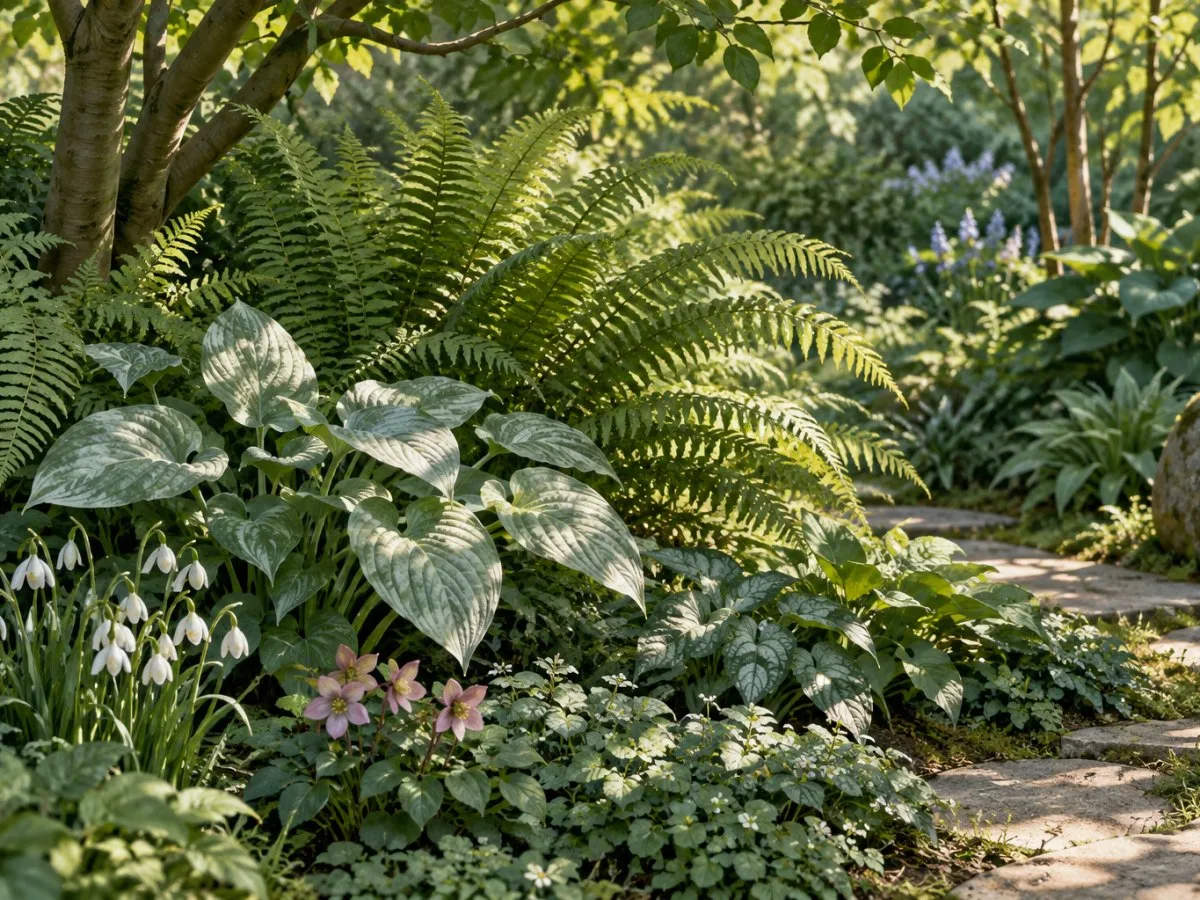
In a low-light space, foliage can sustain visual interest when flowering is brief or less abundant. Large, finely divided, glossy, silver or variegated leaves bring contrasts of shape and texture. Flowers, meanwhile, can be distributed across the season rather than concentrated in a single moment.
A planting can be organised around three complementary functions:
- Structure: Ferns and plants with evergreen or semi-evergreen foliage retain a recognisable presence beyond the peak flowering period.
- Seasonal accents: Bulbs and early- or late-flowering perennials signal seasonal change.
- Low cover: Plants that spread near the ground create visual continuity between taller specimens.
This structure does not mean that every plant suits every kind of shade. Selection still depends on light levels and moisture. Ground cover can help reduce bare soil and the establishment of unwanted plants. While plants are getting established, an organic mulch can also help conserve surface moisture.
Combine Early Flowers with Lasting Foliage
One clear strategy for partial shade is to make use of the light in early spring, before deciduous trees are in leaf. Bulbs and early-flowering perennials can take advantage of this window, while ferns and persistent foliage provide continuity.
Examples include the dwarf daffodil ‘Tête-à-tête’, which flowers in spring; the lungwort ‘Diana Clare’, with violet-blue flowers from late winter to late spring; and Brunnera macrophylla ‘Jack Frost’, whose silver, heart-shaped leaves are edged and veined with green and accompanied by blue spring flowers. The combination of silver and green foliage with flowers in different shades creates contrast without relying on one mass of colour.
Ferns offer another scale of texture. Dryopteris affinis forms a rosette of upright fronds that change from yellow-green as they unfurl to a richer green. Polystichum polyblepharum retains glossy, dark fronds arranged in a rosette. Together, the upright and arching shapes of fern fronds can balance the broader leaves of perennials.
The aim is not to copy an entire planting scheme, but to recognise its relationships: a foliage base, spring flowers, and contrasts in size and texture. A mature planting can create depth and cover the ground more fully, but its eventual appearance and growth depend on the conditions in the particular garden.
What Annuals, Bulbs and Perennials Contribute
Each group plays a different role in the garden’s seasonal rhythm. Annuals complete their life cycle in one growing season and can fill gaps or add summer colour, including in containers. Bulbs are underground storage organs that are usually planted while dormant; many produce a concentrated display, often early in the year. Perennials live for several years and may provide flowers, persistent foliage or seasonal foliage.
| Group | Design contribution | Documented examples to consider |
|---|---|---|
| Annuals | Seasonal colour and the option to fill gaps or containers | The available information describes their life cycle and uses but does not identify a specific selection of annuals for shade here. |
| Bulbs | Seasonal accents, especially in spring | Daffodil ‘Tête-à-tête’ and Galanthus nivalis. |
| Perennials | Foliage and flowers that return over several years | Pulmonaria ‘Blue Ensign’, Brunnera macrophylla ‘Jack Frost’ and Anemone × hybrida ‘Honorine Jobert’. |
| Ferns | Frond texture and structural presence | Dryopteris affinis, Polystichum polyblepharum and Asplenium scolopendrium. |
| Perennial ground cover | Low continuity and coverage of bare areas | Ajuga reptans ‘Burgundy Glow’, Bergenia ‘Overture’ and Waldsteinia ternata. |
These examples are not a universal list or a guaranteed combination. Some are suited to deep shade, others to brighter or dappled shade, and moisture requirements vary. Check each plant’s suitability against the conditions on site.
Match Plant Choices to the Degree of Shade
Light or Dappled Shade
Sites open to the sky but protected from direct sun, or lit through branches, allow for a wider range of foliage contrasts and flowering plants. Options listed for lighter or dappled shade include Anemone × hybrida ‘Honorine Jobert’, with white flowers from late summer to mid-autumn; Astilbe ‘Fanal’, with crimson flower spikes in early summer; and Trillium grandiflorum, with white flowers in spring and summer.
For ground cover, Ajuga reptans ‘Burgundy Glow’ offers silver and green leaves that may turn reddish, while Waldsteinia ternata combines lobed leaves with yellow flowers in late spring and early summer. Their ground-covering habit and contrasting foliage are useful features, but their dimensions and behaviour should not be assumed to be identical in every garden.
Deep Shade
Intense shade narrows the selection, particularly when combined with dry, poor soil. Perennial options listed for these locations include Alchemilla mollis, with pale-green, lobed leaves and tiny greenish-yellow flowers from early summer to autumn; Epimedium × versicolor ‘Sulphureum’, with pale-yellow flowers in spring; and the low-growing Convallaria majalis.
A plant’s inclusion on a list for deep shade does not mean it will thrive in every dark location. Beneath conifers or dense evergreen trees, in particular, conditions may be dry and the range of suitable plants very limited. Where shade is very dense and the soil stays dry or impoverished, a diverse planting should not be expected to succeed without further consideration of the site.
Damp Shade
Moisture creates other possibilities, especially for ferns and plants with lush foliage. Adiantum venustum has finely divided fronds; Asplenium scolopendrium has entire, glossy, evergreen fronds; and the young fronds of Dryopteris erythrosora emerge coppery before turning green.
Very wet locations require an additional distinction: not every shade plant tolerates soil that stays saturated for prolonged periods. Fern choices for very wet shaded sites can include Athyrium filix-femina and Osmunda regalis. Moisture is therefore not a simple scale on which “more is better”; it must suit the plant selected.
A Practical Planning Checklist
- Describe the light at different times. Note direct sun, filtered light and areas that remain dark; observe again as tree foliage changes.
- Assess light and moisture separately. A shaded spot beneath a tree may be dry because of root competition, while another may stay damp.
- Choose a function for each area first. Decide whether you need structure, seasonal flowers, low ground cover or a mix of these roles.
- Combine flowering times and textures. Depending on the site, pair evergreen or semi-evergreen foliage with flowers in spring, summer or autumn.
- Allow time for plants to establish. Shade-adapted plants may need monitoring and watering during their first spring and summer. Ground cover also takes time to form.
- Review how plants perform, not just their labels. If a plant produces little foliage or few flowers, reconsider the degree of shade, moisture and whether the species suits the site.
The central idea is straightforward: treat shade as a combination of light, moisture and structure, and design around those differences. Contrasting foliage and seasonal succession can give a space character even when flowering is limited.
At a glance
Scope
Editorial reading; this is not a site visit or technical assessment.
Sources and references
Shade planting: annuals, bulbs and perennials | RHS Advice ↗20/10/2026
Shade Gardening Tips and Plant Ideas | RHS Advice ↗20/10/2026
Shade with Spring Flowers and Ferns | RHS Advice ↗20/10/2026